
Growing up in the sixties and seventies right here in Nigeria, food in homes was the least of worries that parents had to contend with. Everyone had food to eat and no one was likely to go home and to bed at night with empty stomach. Although it was a different ball game whether the feeding was under-nourishing, or led to malnourishment over time. But it was common knowledge that food was sufficient and did not cost an arm and a leg to feed the families. That takes me back to the tales on the fantastic yields of cocoa in the Southwest. The 25-Storey “Cocoa House” was built when the late sage Chief Obafemi Awolowo was Premier.
There were also groundnut pyramids scattered in the North, while Midwest and the East had rubber plantations and palm oil respectively in abundance. These feats dated back to the colonial days when the ‘masters’ carried out their home instructions. They were posted to Nigeria to teach the conquered territories how to produce plenty cash crops, which they exported to their home countries. In exchange they gave mirrors, cognac and later on paid paltry monetary compensation in a skewed balance of trade. Their mission succeeded and we were the losers for their cunningness.
Eventually, there was discrimination in the society, as those who farmed for the whites created a class symbol. The majority of our able bodied farmers, rivaled and abandoned food crops production in preference for the cash crops. The attraction to the cities blossomed and everyone wanted to be the smart middleman instead of farming by himself or herself. The influx of people to the cities soon created a shift in the demography, with mostly youthful persons preferring to hustle and get paid peanuts, rather than remain in their villages. It was not only the oil boom that made rural-urban drift of the erstwhile farmers in the villages a challenge.
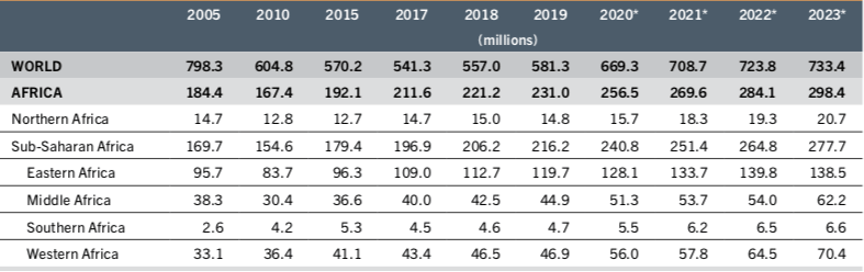
That was the signpost and beginning of what is today the food crisis in Africa with undernourished people increasing yearly across all its regions (See Table 1). In that distant past, life was good and Kwashiokor was only seen as images in the textbooks to describe what existed in other places far away. Today, it is no longer like that and we see children suffering from metabolic disorders dotting our landscape.
At independence and in later years, it dawned on us that ignorance was the reason for the unnecessary praises heaped on us for building the groundnut pyramids and storing rubber and cocoa in huge tonnages. The smarter guys only came from abroad and took them away, added value and brought them back to us more expensive as chocolate or part of candies of all sorts. Because they did not teach us value chain principles, they bought and shipped our raw products overseas cheaply.
A lot of foodstuff and the cash crops were wasted, if they could not be consumed immediately due to poor storage and no value chain addition. We have continued the wastages up till today, and recent reports have it that even up to 40-60% post harvest yields in Nigeria are lost year in year out.
It is noteworthy that the ability to feed was largely because almost everyone had one type of farm or the other close to them and sizeable enough to meet nuclear family needs. I believe the new workable strategy should be to incentivize the citizenry to repeat such potential gain again. Poverty was never defined by availability or lack of food. The popular parlance to push away inferiority complex was always in the cliché: “you are not the one feeding me”.
There was then a highly populated middle class in the society that farmed in government allocated and reserved agricultural fields. Farmers were satisfied with their jobs and were not shy being so called. Nigeria would have to reenact this reality and support value chain on all products, to banish hunger and attain food sufficiency and food security. The rural-urban drift has created population explosion in the cities, and the number of rural farmers has continued to thin out, even as they are threatened by insecurity in their bushes.
TABLE 3: THE CONCENTRATION AND DISTRIBUTION OF FOOD INSECURITY BY SEVERITY IN 2023
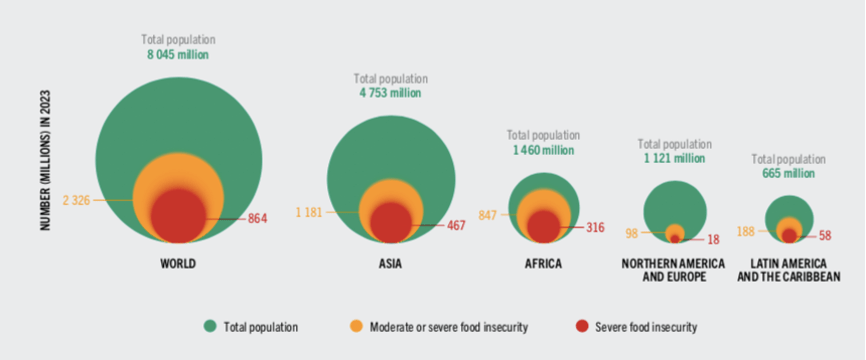
Today, governments after governments have continued to promise that agriculture was going to be prioritized for a Nigerian economy without oil. But nothing in their budgetary provisions or actual releases, at either the federal or states point towards that at all. We have underrated and abandoned the hidden treasure for this country, which resides in Agriculture, be it crop or livestock production. It’s more enduring than the proceeds from oil, and we can boast of being able to feed ourselves, which is the food security much talked about.
FIGURE 4: THE PREVALENCE OF FOOD INSECURITY IS HIGHER IN RURAL AREAS
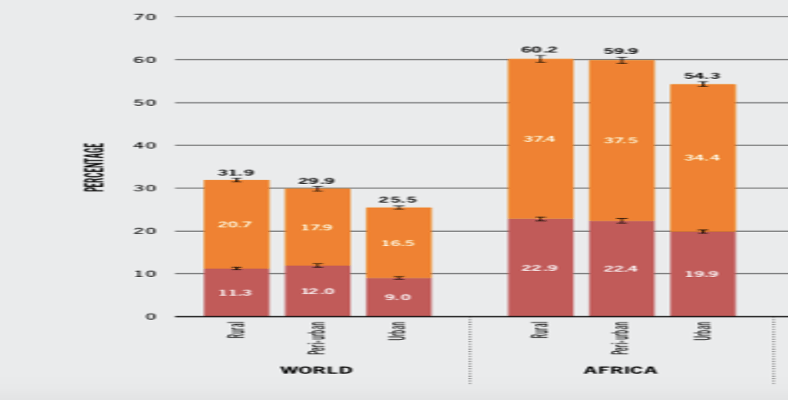
Unfortunately even the rural farmers don’t have enough to feed their households any longer, because of poverty (Table 4). A true revolution back into farming and much beyond mere declaration of food security is what Nigeria needs to ensure all year round availability of foods for its citizens.



 farmalert.online
For questions Leave a Reply