

Recently, an article was written by Gani Enahoro, DVM, mni, featured on the Driven by DATA platform with the title, ‘Corrupt Data; A Weapon of Mass Destruction’. Basically, the write-up lampooned a recent presentation at an international conference, which painted a dataset that grossly misrepresented the animal health workforce in Africa. Africa was allocated approximately 30, 000 Veterinarians and over 130, 000 Veterinary paraprofessionals (VPPs) for well over 2.946 billion heads of livestock resources (chickens, cattle, sheep, goats and pigs only). These values translate to a vet per over 98,000 animal resources or a VPP for every 22,656 livestock. If accepted, it simply points to the fact that a lot of animal resources are underserved or are left unattended to in a space where technology is not yet optimized.
In contrast, the Asian continent was allocated approximately 520,000 veterinarians and over 900,000 veterinary. This gross misrepresentation, at least for the African countries, is worth reflecting on as stakeholders in the livestock industry in Africa. Granted that many African country have left its animals resources (livestock and wildlife) unattended for a relatively long time and are underutilizing the enormous resources and potentials in food security and livelihoods/economic catalysts associated with the industry, and are focusing primarily on the limited extractive industry (oil, gold, and other minerals), much more without valorization.
This observation by Enahoro triggered a rapid evaluation of the animal health workforce in Africa on behalf of Driven by DATA. It should be noted that we live in a society where data has become an important aspect of our everyday living. It now leads our ability to inform decisions, drive innovations, and improve efficiency through informed decision-making, policy making and governance, in identifying trends and patterns, tailoring outputs to specific needs, in monitoring and evaluation of government services and inputs, in risk evaluation and management, in driving innovation, and for accountability and transparency. Basically, data is a lifeblood driving us into the future. The danger of inaccurate data can therefore be better imagined in view of its enormous potentials in solving complex global problems and for futuristic planning.
Based on our findings, Egypt has at least 29,244 veterinarians compared to the allocated 5,000; South Africa has 4,221 while the report gave it 3,000, Nigeria has at least 11,369 veterinarians on its register compared to a paltry 2,000 given to it. For Ethiopia and Kenya, 1,500 and just over a thousand were allocated compared to 11,799 and 6,880 based on our findings. In total, we documented at least 115,311 veterinarians in Africa, an 284.4% disparity from the presented data. For the veterinary paraprofessionals, we documented 119,644, a reduction from the 130,000 presented for the African continent (see the linked spreadsheet).
This attempt to document the animal health workforce across Africa is the first most comprehensive in-house effort and an improvement over previous dataset. It is understood that there is a dearth of animal health workforce, and associated data, not only in Africa, but also elsewhere across the world. With such significant shortfall in quantity and quality, the implications on service deliveries, public health, outbreak investigations, field and laboratory surveillance, veterinary quality systems, reporting, data management, data processing and drawing inferences to inform empirical decision making for field actions are obvious. Correct and accurate data are needed to deliver effectively on the services above. The animal health workforce is also very useful in the transdisciplinary areas of One Health, and have recently contributed to pandemic prevention, field work, training and diagnostics during the recent COVID-19 pandemic.
The need for in-country comprehensive documentation by the various professional Councils is needed now more than ever. The South African Veterinary Council (SAVC) has a comprehensive template that other countries in the African continent can borrow from and customize to their country needs. Various efforts by the international donor agencies to support workforce development is ongoing and for the animal health workforce in Africa to benefit effectively, such data will become obvious to convince these funders, bilateral and multilateral partners on the need to make adequate investment in the various areas of training and capacity development identified for the animal health workforce.
The current knowledge also emphasized the importance of regional cooperation and workforce mobilization to countries where they are sorely needed direly as countries like Niger, Liberia, Mauritania, Eritrea, Gabon, Equatorial Guinea and Sao Tome & Principe either have missing data or are currently under resourced. This cooperation can also enable customized training per country to meet the need of those under-resourced countries.
The Nigerian President, His Excellency, Bola Ahmed Tinubu, has recently reaffirmed that neglecting livestock farming and relying on dairy imports was a mistake that must be corrected, and that a robust framework will be created to stimulate prosperity in the sector. Such a promise can only piggy-back on an effective and adequately accounted for workforce.
While the current data gathering effort can be improved significantly, it shows that Africa professional councils should lead the change and generate its own data gathering effort to properly document its own resources and not depend on external sources to mobilize data for Africa.
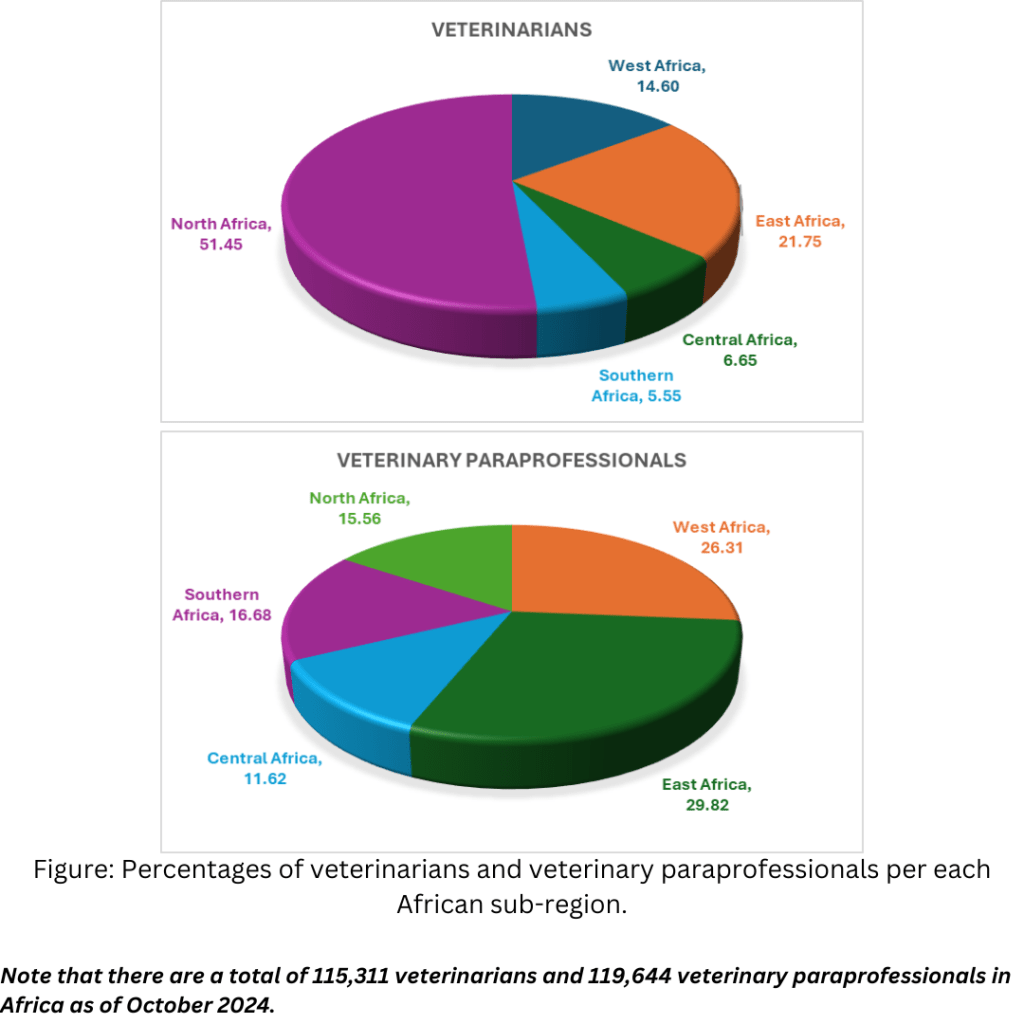
Click on the link below to access the animal-health workforce sheet as of October 2024.
https://bit.ly/animalhealthworkforce


 farmalert.online
For questions Leave a Reply