
A study carried out by farm alert – November, 2024
Executive Summary
This report provides a comprehensive analysis of the diagnostic capabilities and challenges faced by veterinary clinics across the Federal Capital Territory (FCT), Abuja. Conducted by Farm Alert in October 2024, the study reveals critical gaps in the availability of diagnostic infrastructure, as well as the barriers hindering improvements in diagnostic services. The findings underscore the vital role of the private sector in veterinary care, the need for more accessible and modern diagnostic tools, and the enthusiasm within the veterinary community for capacity-building initiatives.
Introduction
Access to quality animal healthcare is crucial to safeguarding the health and productivity of livestock, which are central to Nigeria’s agricultural sector and economy. In response to the growing need for effective veterinary care in the Federal Capital Territory (FCT), Abuja, the Data and Research team at Farm Alert conducted a field study to assess the diagnostic capabilities of veterinary centers in the region.
This report outlines the findings, challenges, and potential solutions, with an emphasis on diagnostic infrastructure, the private sector’s role, and opportunities for enhancing veterinary services through targeted investments.
Ownership and Demographics
- Private vs Government Ownership:
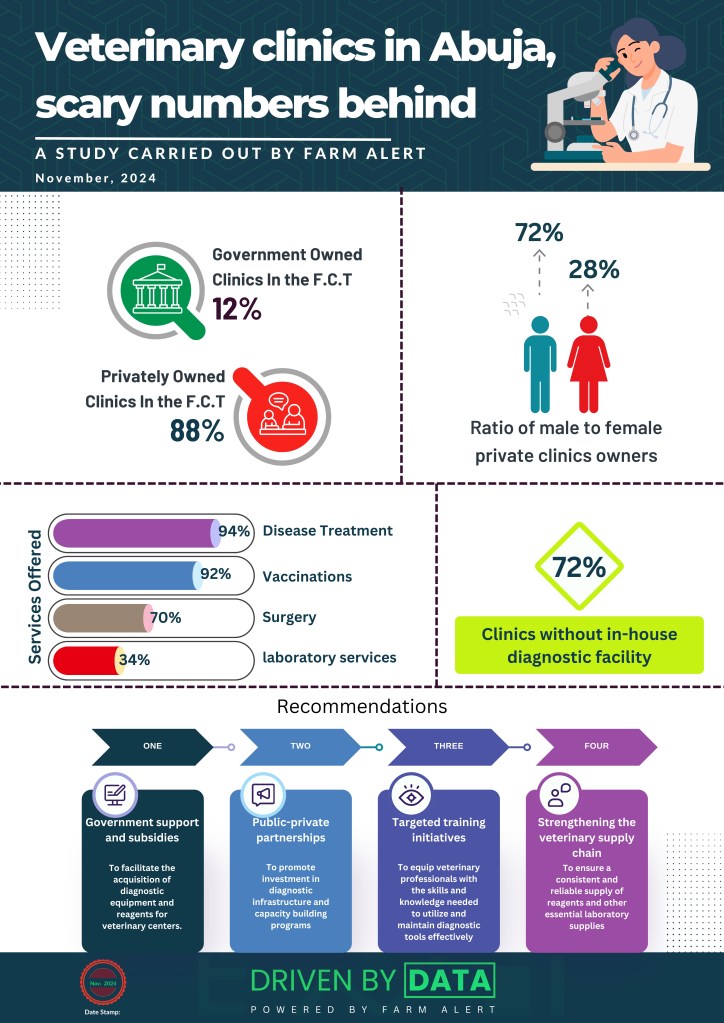
The majority of veterinary centers in the FCT are privately owned, accounting for 88% of the total. Government-owned centers represent only 12%, indicating the central role of the private sector in providing veterinary services in the region.
Implication: The limited government involvement in veterinary services can create barriers to access for lower-income earners, as private clinics are often more expensive. The high reliance on the private sector may restrict affordable veterinary care, particularly in underserved or lower-income communities. - Gender Disparity in Private Ownership:
There is a notable gender disparity among private center owners. 72% of privately owned centers are managed by male sole veterinarians, while 28% are owned by female veterinarians. This discrepancy suggests the need for initiatives to support female veterinary entrepreneurs and foster gender equity in the veterinary sector.
Implication: The significant gender gap in veterinary ownership suggests that veterinary medicine may be perceived as a more masculine profession, potentially discouraging young girls with aspirations to pursue this career. Efforts to encourage and support female veterinary students and professionals are critical to bridging this gap.
Services Offered
- Essential Services:
The majority of veterinary centers offer essential services such as:- Vaccinations: 92%
- Disease Treatment: 94%
- Surgery: 70%
- Diagnostic Services:
However, there is a significant gap in diagnostic services:- Only 34% of centers provide any form of laboratory services.
- A staggering 72% of centers lack in-house diagnostic facilities, which limits their ability to accurately diagnose and monitor diseases. This has implications for disease management and livestock health, as the absence of comprehensive diagnostic infrastructure skews disease understanding and limits effective treatment options.
Implication: With limited diagnostic facilities, most diagnoses are based on clinical signs, making them largely tentative. This reliance on clinical signs alone increases the likelihood of misdiagnosis, undermining the professionalism of the veterinary practice and potentially compromising animal health outcomes.
Barriers to Improved Diagnostics
The study identified several key barriers hindering the expansion of diagnostic services:
- Lack of Diagnostic Equipment (76%): The high cost of acquiring diagnostic tools remains a significant barrier for many centers, preventing them from upgrading their facilities.
- Lack of Access to Modern Diagnostic Technologies (58%): Advanced diagnostic methods like PCR and ELISA are unavailable in most centers, limiting the capacity for accurate and comprehensive disease diagnosis.
- High Cost of Diagnostic Equipment (38%): The financial burden of acquiring state-of-the-art diagnostic machines further compounds the challenges faced by veterinary centers.
- Inconsistent Power Supply (26%): Frequent power outages disrupt the operation of diagnostic equipment and storage of reagents, particularly in rural or peri-urban areas.
- Shortage of Reagents (24%): Limited access to essential laboratory supplies, such as reagents, hinders the ability to conduct necessary tests for disease diagnosis.
Enthusiasm for Capacity Building
Despite these challenges, there is a strong desire among veterinary professionals to improve their diagnostic skills. 98% of respondents expressed interest in training and capacity-building programs focused on enhancing diagnostic capabilities. This eagerness presents an opportunity to invest in strengthening veterinary capacity and improving diagnostic infrastructure.
Conclusion
The findings from this study highlight the current diagnostic challenges faced by veterinary centers in the FCT. While the private sector plays a central role in providing veterinary services, there is an urgent need to address the diagnostic gaps. Without investment in equipment, training, and reliable infrastructure, the capacity of veterinary centers to effectively diagnose and manage diseases will remain constrained.
Recommendations
To address the challenges identified in this study, the following recommendations are proposed:
- Government Support and Subsidies:
The government should offer subsidies or financial support to veterinary centers to facilitate the acquisition of diagnostic equipment and reagents, making it more affordable for centers to enhance their diagnostic capabilities. This could include the establishment of additional government-owned clinics to ensure more affordable access, especially for lower-income earners. - Public-Private Partnerships:
Collaboration between the public and private sectors can promote investment in diagnostic infrastructure and the development of capacity-building programs for veterinary professionals. - Targeted Training Initiatives:
Providing targeted training programs to veterinary professionals on the use and maintenance of diagnostic tools is crucial for ensuring the effective deployment of new technologies and improving disease diagnosis. - Strengthening the Veterinary Supply Chain:
Ensuring a consistent and reliable supply of laboratory reagents and other essential diagnostic supplies is vital for supporting diagnostic activities in veterinary centers. - Encouragement for Female Veterinary Professionals:
Awareness programs should be established in veterinary schools, especially in Abuja, to encourage female veterinarians to pursue clinical practice after graduation. Financial support, mentorship, and leadership development programs are also crucial to empowering women in the field. - Encouragement for Equipment Acquisition:
Private veterinary centers in Abuja should be incentivized to invest in diagnostic equipment that can enhance their diagnostic capabilities, ensuring better disease management and improving professional standards.


 farmalert.online
For questions Leave a Reply