
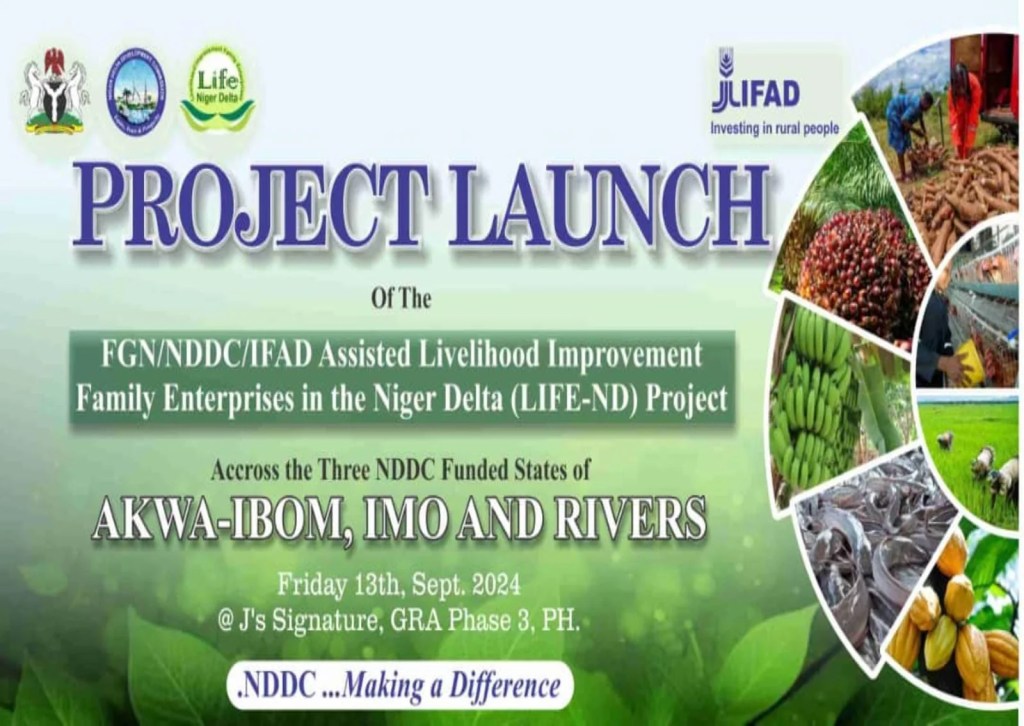
In a strategic move to boost rural livelihoods and agribusiness development in the Niger Delta, the Livelihood Improvement and Family Enterprises in the Niger Delta (LIFE-ND) project has officially commenced operations in Akwa Ibom, Rivers, and Imo states.
Backed by the International Fund for Agricultural Development (IFAD) and the Federal Government of Nigeria, the LIFE-ND project aims to catalyze sustainable agri-entrepreneurship, generate employment for youth and women, and enhance food security in the region.
A New Phase Begins in the Niger Delta
The National Project Coordinator, Dr. Abiodun Sanni, announced the project’s rollout following a recent sensitization and inspection tour conducted by project officials in the target states. This phase is financed by the Niger Delta Development Commission (NDDC), while a previous phase covered six other Niger Delta states with direct IFAD funding.
Each participating state will empower 4,250 rural beneficiaries, with a strong emphasis on gender inclusivity and community ownership.
“We’ve adopted a community-first approach—sensitizing locals, engaging traditional leaders, and identifying skilled trainers (incubators) and willing learners (incubatees),” Sanni explained.
This foundational engagement paves the way for profiling candidates for the LIFE-ND incubation model, which is inspired by the indigenous master-apprentice tradition widely practiced in Eastern Nigeria.
Commodity Priorities by State
To tailor the program to each region’s agricultural strengths, the following commodity value chains have been selected:
- Akwa Ibom: Cassava, Oil Palm, Poultry, and Aquaculture
- Imo: Cassava, Rice, Poultry, and Aquaculture
- Rivers: Cassava, Plantain, Poultry, and Aquaculture
This strategic focus will help unlock the economic potential of local farmers while creating ripple effects in food production and rural employment.
Real Stories, Real Impact
Already, farmers and participants in Imo State are witnessing transformation.
Mr. Mbaeyi Emeka, a former subsistence farmer and now an incubator at Prince Mbaeyi Emeka Farm, shared how the LIFE-ND project enabled him to upscale his cassava enterprise into a commercially viable venture.
“There’s real money in cassava. I came back from Italy and found purpose in farming. Today, I’m self-sufficient and employ others. I urge youths to see farming as a gateway to prosperity, not just an alternative.”
Mrs. Ifeoma Njoku, one of Emeka’s incubatees, also highlighted the financial benefits of cassava production, especially for women.
“This program has truly changed my life. I can support my household and encourage more women to tap into the potential of agriculture,” she said.
At Petros Poultry Farms in Ngor Okpala, Mr. Young-man Soseipiri, the Assistant Farm Manager, is training a new generation of poultry farmers in broiler and layer production, noting how the project fosters hands-on learning and capacity building.
Funding and Future Outlook
The LIFE-ND project, launched in 2019, has a six-year initial phase, with a vision for continuity through future investments.
- IFAD has invested $60 million to support states like Abia, Bayelsa, Cross River, Delta, Edo, and Ondo.
- The NDDC recently committed $5 million ($2.5 million each in August 2024 and January 2025) to kickstart and scale the project in Akwa Ibom, Rivers, and Imo.
The Federal Ministry of Agriculture and Food Security leads implementation nationally, with the NDDC acting as a core delivery partner in the newly added states.
Conclusion
The LIFE-ND initiative is more than a development project—it’s a blueprint for rural empowerment, proving that with the right partnerships and community-driven models, agriculture can be a game-changer for thousands of Nigerian households.


 farmalert.online
For questions Leave a Reply