
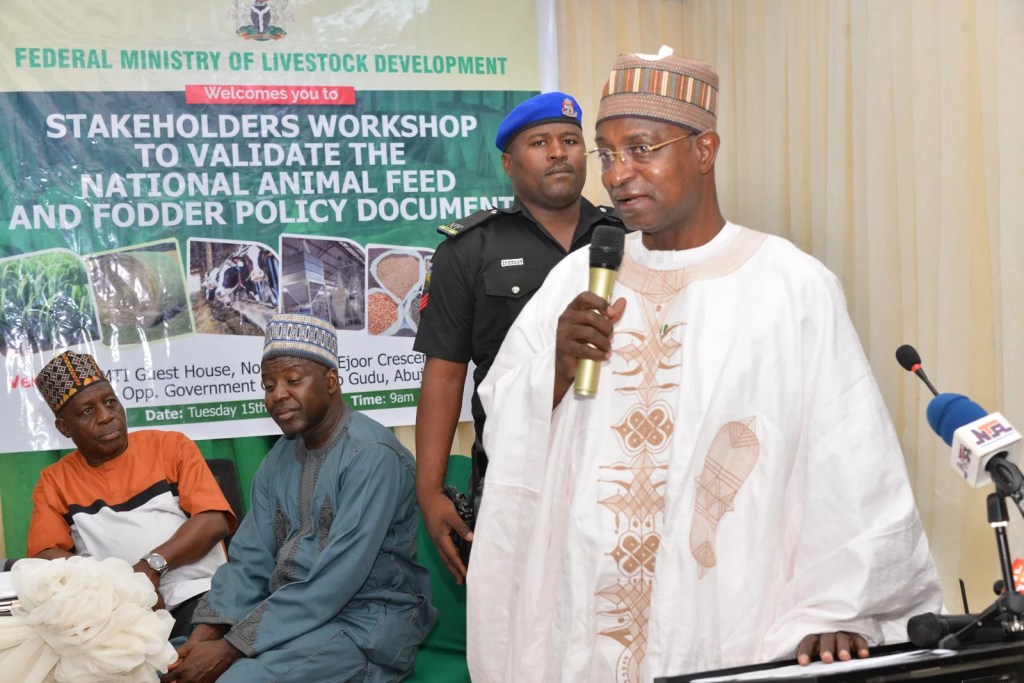
In a significant step toward enhancing Nigeria’s livestock industry, the Federal Ministry of Livestock Development has formally initiated the validation of the National Animal Feed and Fodder Policy. The policy, years in the making, aims to tackle long-standing challenges in the feed and fodder ecosystem while unlocking new opportunities across the livestock value chain.
The validation workshop was held at the ARMTI Guest House in Abuja, gathering stakeholders from the public and private sectors, development partners, and academia to refine a framework expected to reshape livestock production and management in Nigeria.
Why This Policy Matters
Speaking at the event, Minister of Livestock Development, Idi Mukhtar Maiha, emphasized that feed and fodder are foundational to sustainable livestock production. He described the policy as a “strategic intervention” to address persistent challenges related to feed quality, availability, regulatory frameworks, and private sector involvement.
Maiha outlined the Ministry’s broader ambition to double Nigeria’s national herd to over 398 million animals and grow the livestock sector’s GDP contribution from $32 billion to $74 billion by 2035.
“We can’t talk about livestock transformation without solving the feed problem,” he noted. “This policy is central to reducing production costs, improving animal productivity, and ultimately ensuring food security.”
Key Focus Areas of the Policy
According to Winnie Lai-Solarin, Director of Ruminants and Monogastrics Development, the policy goes beyond just growing grass. It provides a holistic roadmap covering:
- Feed and fodder production
- Processing and marketing
- Utilisation frameworks
- Legal and regulatory support
- Land access
- Training and capacity building
- Monitoring and enforcement mechanisms
Solarin also noted that feed accounts for more than 70% of the total cost in animal production, making this intervention critical to lowering costs for farmers and resolving farmer-herder clashes often fueled by competition for grazing and water.
“This is not just a policy document — it’s a catalyst for national stability, agribusiness growth, and rural development,” she said.
Private Sector Engagement and Data-Driven Action
Professor Maikano Ari, President of the Nigeria Feed and Fodder Multi-Stakeholder Platform, urged increased private sector participation, investment in data systems, and structured grazing zones. He pointed out that Nigeria’s diverse agro-ecological zones—ranging from Sahel to Savannah—possess immense potential for developing strategic pasture reserves.
“We need a structured distribution network that connects high-fodder production zones to livestock-demand areas. With the right structure, fodder can become a commercial asset, not just a natural resource,” he emphasized.
Ari also noted that international actors are already exploring Nigeria’s fodder potential — making it critical for local systems to scale up and remain competitive.
Objectives and Targets
Professor Eustace Iyayi, the lead technical adviser on the policy, outlined its core objectives:
- Increase feed and fodder output by 20% annually
- Ensure 50% of livestock farmers adopt commercial production practices within 5 years
- Establish quality and safety standards
- Create a conducive environment for public-private partnerships
- Encourage inclusive participation—particularly of women and youth
The final draft of the National Feed and Fodder Policy is expected to be presented to the Federal Executive Council (FEC) for adoption in the coming weeks.


 farmalert.online
For questions Leave a Reply