
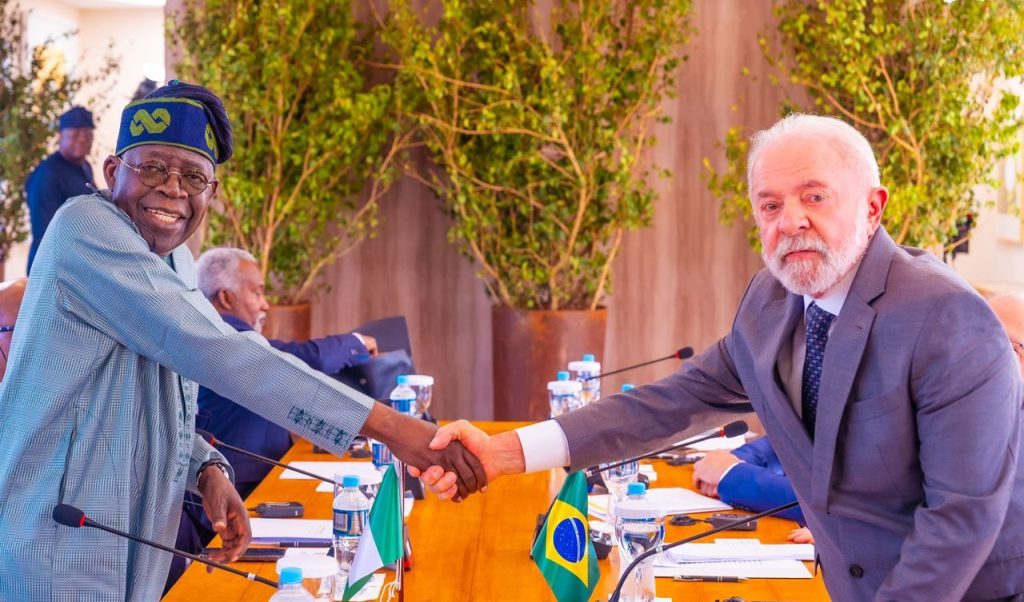
In a high-level bilateral meeting held at Copacabana Forte, President Bola Ahmed Tinubu reaffirmed Nigeria’s commitment to removing all administrative and structural barriers impeding progress in the agriculture and livestock sectors. This pledge was made during discussions with Brazilian President Luiz Inacio Lula Da Silva, as both nations explored ways to deepen collaboration in food production, agricultural research, and economic transformation.
President Tinubu emphasized that Nigeria is actively restructuring its economy to align with global competitiveness, especially in agriculture, where the country already possesses significant potential. He cited bureaucracy as a major challenge delaying progress and assured his Brazilian counterpart that all technical and legal delays affecting trade, aviation, agriculture, energy transition, mining, and natural resource development will be addressed.
Highlighting Brazil’s global reputation for cutting-edge agricultural research and high food production rates, President Tinubu expressed optimism that strategic partnerships in livestock, fisheries, poultry, and the blue economy would yield substantial benefits. He reiterated that subnational governments in Nigeria would play a crucial role in complementing federal efforts to use agriculture as a tool for job creation, food sovereignty, and rural development.
President Lula, in response, agreed that existing Memoranda of Understanding (MOUs) would be reviewed and swiftly signed. He affirmed Brazil’s readiness to partner with Nigeria through joint initiatives in agricultural innovation and livestock development. Lula also noted that outdated bureaucratic systems would be dismantled to speed up bilateral progress.
Senator Abubakar Kyari, Nigeria’s Minister of Agriculture, highlighted President Tinubu’s consistent emphasis on food security and pointed to the nation’s comparative advantage in fertilizer production, which could be scaled for broader agricultural gains.
Also speaking at the meeting, the Minister of Livestock Development, Idi Mukhtar Maiha, identified key areas of potential partnership with Brazil. These include disease surveillance and control, sanitary and phytosanitary standards, and genetic research to improve livestock breeds in Nigeria.
Several state governors, including those from Lagos, Ogun, Delta, Niger, and Benue, participated in the discussions. Governor Dapo Abiodun of Ogun State stressed the importance of state-level alignment with federal agricultural initiatives and applauded the inclusion of a business forum during the presidential visit, aimed at generating investment opportunities and private sector involvement.
With the participation of key figures such as Foreign Affairs Minister Yusuf Tuggar and NIA Director General Mohammed Mohammed, the meeting underscored Nigeria’s intent to leverage international partnerships to revamp its agricultural landscape and advance national food security goals.


 farmalert.online
For questions Leave a Reply