
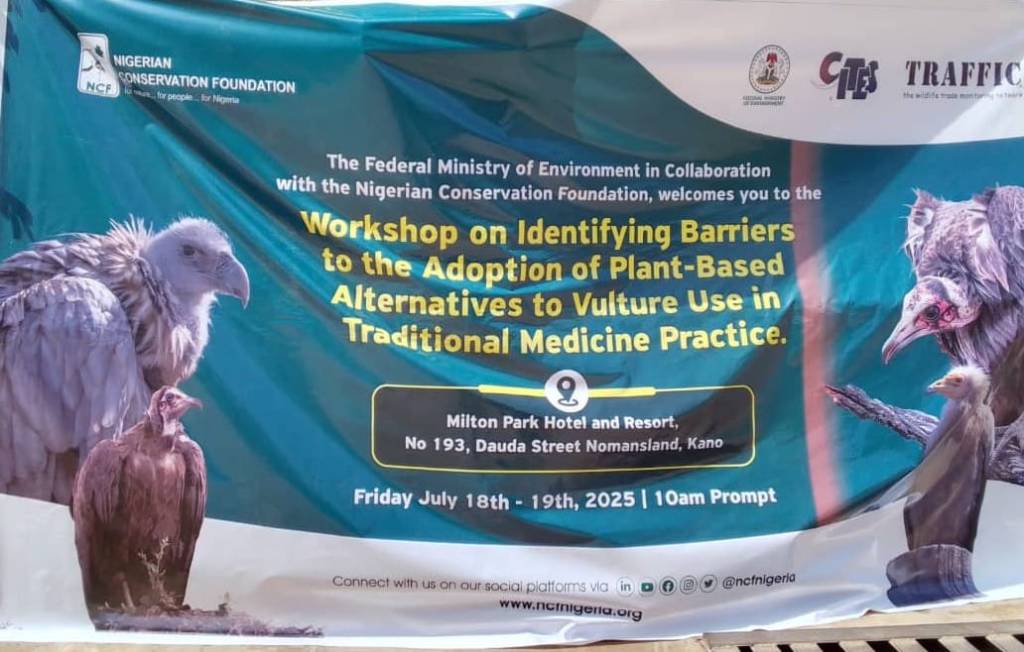
In a bold step toward biodiversity preservation, the Federal Government of Nigeria is finalizing a new legal framework to intensify the protection of endangered wildlife species, including vultures, which are increasingly threatened by unsustainable traditional practices.
This development was revealed during a two-day stakeholder workshop held in Kano, themed “Reducing the Demand for Vultures in Belief-Based Use Practices.” The event was jointly organized by the Federal Ministry of Environment and the Nigerian Conservation Foundation (NCF) to spotlight the critical need for vulture conservation and to address the broader issue of illegal wildlife trade in Nigeria.
Legal Backing to Curb Wildlife Crimes
Speaking at the event, Dr Ama Moses, Director of the Forestry Department at the Federal Ministry of Environment, confirmed that a bill to safeguard endangered species had successfully passed through both chambers of the National Assembly and is awaiting presidential assent.
Once enacted, the law will impose harsher penalties on individuals and groups involved in the poaching, trafficking, or illegal use of endangered animals, particularly those used in belief-based traditional medicine.
Dr Moses, represented by ministry official Tijjani Zakirai, noted that enforcement of the legislation will serve as a crucial deterrent against wildlife crimes, while reinforcing Nigeria’s commitment to biodiversity conservation.
Vultures at the Brink of Extinction
One of the key focal points of the workshop was the alarming decline in vulture populations due to their widespread use in traditional medicine and rituals. As scavengers, vultures play a vital ecological role by preventing the spread of disease through carcass disposal, yet many communities continue to hunt them for spiritual and medicinal purposes.
To address this, the Federal Government has developed a National Vulture Conservation Strategy, alongside public awareness campaigns, educational outreach, and multi-stakeholder engagement programs that emphasize the ecological value of vultures.
Collective Action from Stakeholders
Delivering remarks at the event, Dr Joseph Onoja, Director-General of the NCF—represented by Dr Stella Egbe, Species Programme Lead—emphasized the importance of collaboration between government, NGOs, traditional practitioners, and the public in safeguarding endangered species.
The workshop gathered a wide array of participants including traditional herbalists, wildlife experts, NGOs, media representatives, and state officials. A key contributor, Sani Tsamiya Babba (Sarkin Shimfida), a renowned traditional healer, discussed the historic use of vultures in herbal medicine and highlighted the urgent need for public education on available alternatives.
Also present was Alhaji Ahmad Sawaba, Special Adviser on Wildlife Conservation to the Kano State Governor, who expressed the state’s pride in hosting such a pivotal event, reiterating the government’s dedication to species protection.
A Path Toward Sustainable Conservation
As Nigeria moves closer to enacting stronger wildlife legislation, workshops like this one play a pivotal role in bridging the gap between policy and practice. By engaging both conservation professionals and traditional medicine practitioners, the country is taking a more inclusive approach to wildlife protection.
The event concluded with technical paper presentations, strategic dialogue sessions, and renewed commitments from all participants to protect Nigeria’s most vulnerable species before they vanish forever.


 farmalert.online
For questions Leave a Reply