
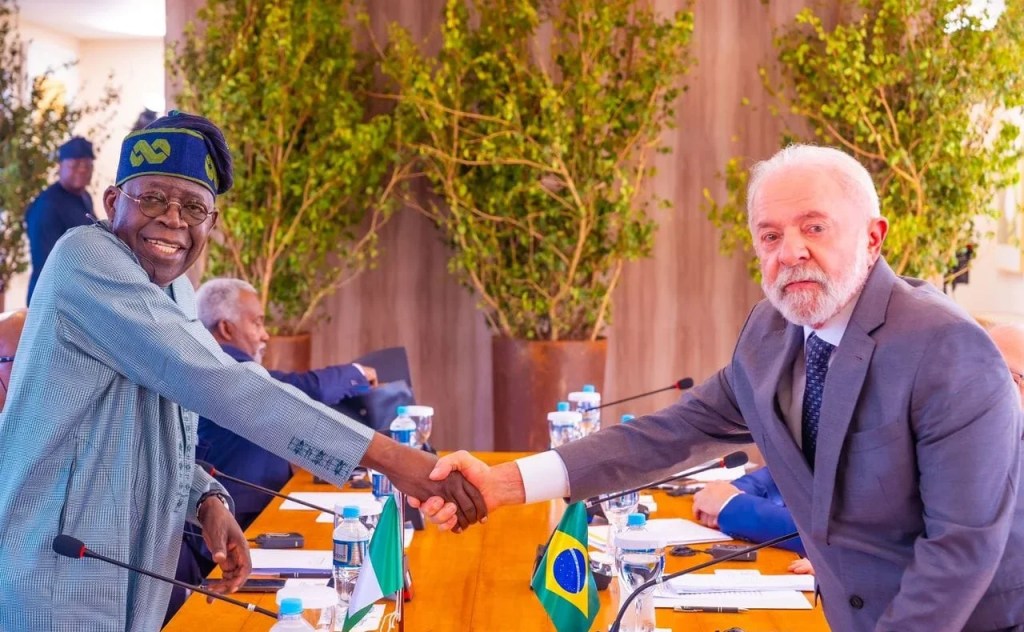
President Bola Ahmed Tinubu has embarked on a two-day state visit to Brazil at the invitation of President Luiz Inácio Lula da Silva, with a strong focus on revitalizing bilateral relations in agriculture, livestock, aviation, and trade.
During the high-level discussions in Brasília, President Tinubu described the engagement as a renewal of the “historic relationship” between both nations, emphasizing shared goals of economic growth, food security, and cultural exchange.
Aviation Connectivity Restored
A major outcome of the summit is the restoration of direct flights between Lagos and Rio de Janeiro, facilitated under a Bilateral Air Services Agreement (BASA). Nigeria’s Air Peace and Caverton, alongside Brazil’s Varig Air, will operate the routes. According to Minister of Aviation Festus Keyamo, who will sign on behalf of Nigeria, the move is expected to boost trade, tourism, and investment by improving connectivity and reducing costs.
Agricultural Mechanisation Through the Green Imperative Partnership
Agriculture remains at the center of Nigeria-Brazil cooperation. President Tinubu announced the Green Imperative Partnership (GIP), a $1.1 billion initiative designed to transform Nigerian farming through mechanisation.
The programme will deliver 10,000 tractors and 50,000 units of farm equipment, all assembled locally in Nigeria, with the potential to generate over 100,000 direct jobs and millions of indirect jobs.
Special Adviser to the President, Sunday Dare, highlighted that the initiative would not only modernize Nigeria’s farming system but also strengthen food security and climate resilience, tapping into Brazil’s long-standing expertise in agricultural mechanisation.
Boosting Nigeria’s Livestock Industry
Another key focus is livestock development, with Nigeria seeking to leverage Brazil’s experience in modern animal husbandry. President Tinubu explained that the establishment of Nigeria’s Federal Ministry of Livestock Development was aligned with this vision, aiming to improve productivity, reduce conflicts, and meet the growing demand for animal protein.
“This collaboration with Brazil will provide crucial investment and knowledge transfer, strengthening Nigeria’s livestock sector for long-term economic growth,” Tinubu stated.
Trade and Economic Growth
Trade volumes between the two countries have declined from $9 billion a decade ago to $1.6 billion in 2023. However, President Tinubu remains optimistic, pointing to the rise of non-oil exports which contributed $620 million in October 2024 alone.
Nigeria and Brazil now aim to expand bilateral trade to $2 billion by 2025 and $3.5 billion by 2030, with agriculture and agro-processing expected to drive much of the growth.
Sunday Dare described the partnership as a symbol of South-South cooperation, noting that with Brazil’s advanced farming technologies and Nigeria’s vast arable land, the collaboration has “immense potential to transform agricultural and livestock development across Africa’s largest economy.”


 farmalert.online
For questions Leave a Reply