
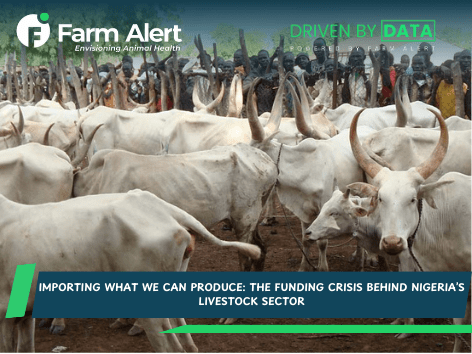
“Nigeria Still Imports Over 60% of Its Meat”- A Sector Rich in Potential, Poor in Investment
Nigeria, a country with vast grazing land, a long pastoral tradition, and an estimated ₦3.2 trillion red meat export potential, still imports more than 60 percent of the livestock consumed annually. That revelation, made by the Minister of Livestock Development, Idi Mukhtar Maiha, before the National Assembly, exposes a troubling contradiction at the heart of Nigeria’s agricultural diversification agenda.
Despite establishing a dedicated livestock ministry in 2024 to reposition the sector, the country remains heavily dependent on imported meat and livestock products. The situation raises urgent questions about policy coherence, funding priorities, and the true state of Nigeria’s livestock economy.
The Import Paradox
According to the minister’s presentation to the joint Senate and House Committees on Livestock Development, Nigeria imports roughly 60 to 65 percent of the meat and livestock products consumed domestically. This dependency persists even though the country possesses:
- Expansive arable and grazing land
- A large population of smallholder livestock farmers
- Growing domestic demand for protein
- Significant export potential in red meat and processed livestock products
The implication is clear: Nigeria is exporting opportunity while importing food.
For a country of over 200 million people with rising urban consumption patterns, this import reliance represents both an economic leakage and a food security vulnerability.
A Ministry Created, But Not Funded
The livestock ministry was created in 2024 under President Bola Tinubu as part of efforts to diversify Nigeria’s economy beyond oil. The rationale was strategic: livestock development could drive rural employment, reduce farmer–herder conflicts through structured systems, improve protein availability, and generate export revenue.
However, funding realities tell a different story.
In his 2025 budget performance report, the minister disclosed:
- The ministry received zero release from its ₦10 billion capital allocation.
- Of the ₦70 billion approved as take-off funding, only ₦20 billion was released.
Capital funding is critical for infrastructure development – ranching systems, feed production facilities, cold chains, processing plants, veterinary laboratories, and disease control systems. Without it, structural transformation becomes nearly impossible.
Lawmakers Express Concern
Members of the National Assembly did not hide their dissatisfaction.
The Chairman of the Committee, Senator Buba Shehu, questioned how a ministry established to drive diversification could be starved of funds. Senate Chief Whip, Tahir Monguno, described the situation as contradictory to the ministry’s founding objectives.
Another committee member, Abdul Ningi, suggested that the zero capital release could indicate internal sabotage and urged immediate intervention.
Their position was straightforward: Nigeria cannot claim economic diversification while neglecting a sector capable of generating jobs, stabilizing rural economies, and boosting exports.
Why Meat Importation Persists
Nigeria’s continued meat importation is driven by several structural challenges:
1. Low Productivity Systems
Much of Nigeria’s livestock production remains extensive and traditional, characterized by low yields per animal.
2. Inadequate Infrastructure
Cold chain systems, modern abattoirs, ranching facilities, and feedlots remain insufficient.
3. Animal Health Challenges
Transboundary diseases and limited veterinary infrastructure reduce productivity and market competitiveness.
4. Poor Value Chain Coordination
Processing, packaging, logistics, and export compliance systems are underdeveloped.
5. Policy–Funding Mismatch
Strategic intent without financial backing undermines implementation.
The Economic Cost of Import Dependence
Importing over 60 percent of consumed livestock has consequences:
- Continuous foreign exchange outflow
- Weak domestic livestock investment
- Stunted rural industrialization
- Limited export competitiveness
- Increased vulnerability to global supply shocks
Meanwhile, countries like Brazil and Argentina have transformed livestock into major export industries by combining strong policy support, infrastructure investment, and value chain integration.
Nigeria possesses comparable ecological potential in several regions. The missing link remains consistent investment and implementation.
A Sector Too Important to Ignore
Livestock is not just about meat. It intersects with:
- Rural livelihoods
- National nutrition security
- Leather and hide industries
- Dairy development
- Youth employment
- Climate-smart agricultural systems
If properly funded and structured, the sector could become one of Nigeria’s most powerful economic diversification pillars.
The Way Forward
To reduce meat import dependence and unlock domestic potential, Nigeria must:
- Ensure full release of capital allocations to the livestock ministry.
- Develop modern ranching and feedlot systems.
- Strengthen veterinary and disease surveillance infrastructure.
- Support private sector investment in meat processing and cold chains.
- Establish clear livestock export standards and trade pathways.
The creation of a dedicated ministry was a bold institutional move. But institutions without investment cannot drive transformation.
Conclusion
Nigeria’s livestock import dependency is not a capacity problem. It is a coordination and funding problem.
The country has the land, the farmers, the demand, and the export potential. What remains is the political and financial commitment to translate policy into productivity.
Until then, Nigeria will continue importing meat while sitting on untapped livestock wealth.
And that is a contradiction the country can no longer afford.


 farmalert.online
For questions Leave a Reply