
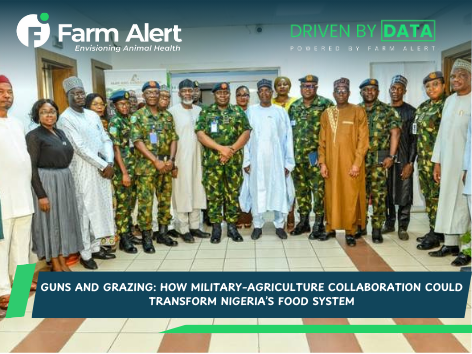
When the Military Joins Hands with Agriculture: Rethinking Food Security as National Security in Nigeria
Nigeria may be witnessing the emergence of a new national security doctrine -one where cattle ranches, grazing reserves, biosecurity infrastructure, and surveillance systems become as strategically important as barracks and airbases.
The recent engagement between the Federal Ministry of Livestock Development and the Nigerian Air Force signals more than institutional collaboration. It reflects a structural shift in how Nigeria defines power, stability, and long-term sovereignty.
When the military joins hands with agriculture, the implications stretch far beyond food production.
1. Redefining National Security Beyond Weapons
For decades, national security has largely been framed around territorial defence, intelligence operations, and combat readiness. Yet modern threats increasingly target food systems -through supply chain disruption, climate shocks, disease outbreaks, and rural insecurity.
By positioning livestock production as a pillar of operational readiness, the Honourable Minister of Livestock Development, Idi Mukhtar Maiha, articulated a forward-looking doctrine: food security is not peripheral to defence; it underpins it.
If defence personnel depend on stable, high-quality food supply chains, then agricultural resilience becomes a matter of strategic preparedness. A military that can support structured livestock systems strengthens its own welfare architecture while contributing to national stability.
This convergence represents a shift from reactive security to preventive security.
2. Securing Five Million Hectares: From Grazing Reserves to Strategic Assets
The Ministry’s inventory of 417 grazing reserves covering approximately five million hectares presents enormous untapped value. Historically underutilised and often poorly structured, these lands could now be repositioned as:
- Structured livestock settlements
- Biosecure production clusters
- Compartmentalised disease-free zones
- Export-ready red meat hubs
With the Air Force’s structured surveillance capabilities, including UAV monitoring and perimeter security — these reserves could transition from loosely managed expanses into highly protected agro-industrial zones.
This could significantly reduce:
- Cattle rustling
- Farmer-herder conflicts
- Illegal encroachment
- Disease transmission risks
The result? Greater investor confidence and lower production risk.
3. Export Transformation: Entering Premium Global Markets
Nigeria’s ambition to create internationally certified disease-free zones positions the country to compete in premium red meat markets, particularly in the Gulf region.
But export competitiveness demands more than cattle numbers. It requires:
- Traceability systems
- Veterinary oversight
- Surveillance infrastructure
- Biosecurity enforcement
- Cold chain integrity
A partnership with the military introduces operational discipline and infrastructure capacity that could accelerate compliance with global sanitary and phytosanitary standards.
If successfully implemented, Nigeria could shift from being a largely domestic livestock economy to a serious export contender, unlocking foreign exchange earnings and diversifying revenue beyond oil.
4. Institutional Farming at Scale: The NAF Model
The establishment of Nigerian Air Force Farms and Agro-Allied Services Limited and the expansion of a 2,000-hectare farm initiative reflect a new model of institutional agriculture.
Rather than small-scale experimental farms, this signals structured, corporate-style agricultural production embedded within a defence institution.
The proposed pilot agricultural estate in Abuja integrating cattle, sheep, goats, and poultry; backed by advanced security systems, suggests:
- Integrated livestock value chains
- Reduced post-harvest losses
- Modern farm management systems
- Potential research and training hubs
Such a model, if replicated across military formations, could serve as demonstration projects for large-scale ranching reform nationwide.
5. Conflict Reduction Through Structured Settlement
One of Nigeria’s most persistent rural security challenges has been the friction between pastoralists and farming communities. Unregulated grazing routes, shrinking pastureland, and climate pressures have intensified disputes.
A structured settlement approach, supported by security-backed monitoring, could reduce:
- Open grazing pressures
- Land-use conflicts
- Informal livestock migration
- Violent confrontations
By integrating biosecurity standards, veterinary services, and improved breeds, productivity per animal could increase, meaning fewer animals generating greater output.
Higher productivity reduces the economic incentive for expansive, conflict-prone grazing patterns.
6. Technology, Surveillance, and the Future of Smart Ranching
The inclusion of UAV surveillance in livestock estates introduces the concept of “defence-enabled smart ranching.”
This could enable:
- Real-time monitoring of herd movement
- Early detection of disease outbreaks
- Perimeter breach alerts
- Data-driven pasture management
Over time, this fusion of defence-grade surveillance and livestock production could place Nigeria at the forefront of secure agricultural infrastructure in West Africa.
7. Human Capital and Capacity Development
The Ministry’s commitment to providing veterinary services, breed improvement access, and technical advisory support to military agricultural ventures suggests a two-way knowledge exchange.
Potential long-term outcomes include:
- Skilled agricultural officers within defence institutions
- Training pipelines for youth in livestock value chains
- Standardised livestock production protocols
- Expanded National Livestock Centres as training hubs
This could gradually professionalise livestock production across both public and private sectors.
8. Economic Diversification in Action
The creation of the Ministry itself aligns with President Bola Ahmed Tinubu’s economic diversification drive. What this partnership demonstrates is implementation — not just policy intent.
If scaled effectively, outcomes could include:
- Increased livestock GDP contribution
- Reduced meat import dependency
- Lower pressure on foreign exchange
- Expanded agro-industrial employment
- Strengthened rural economies
In this model, agriculture is no longer treated as subsistence activity, it becomes strategic infrastructure.
What Could This Ultimately Lead To?
If sustained and properly executed, this collaboration could produce five transformative outcomes:
- A new national security doctrine that embeds food systems into defence planning.
- Modern ranching reform anchored in biosecurity and surveillance.
- Export-grade livestock zones that unlock global market access.
- Reduced rural conflict through structured settlement models.
- Institutional agriculture serving as a scalable blueprint for private investors.
A Defining Moment for Structural Reform
When the military joins hands with agriculture, it signals seriousness of intent. It suggests that food systems are no longer peripheral policy concerns but core state priorities.
Nigeria stands at an inflection point. With five million hectares inventoried, structured reforms underway, and defence institutions stepping into agricultural production, the question is no longer whether livestock can drive economic transformation.
The question is how quickly the ecosystem can align — policy, capital, security, and technical expertise — to unlock its full potential.
If done right, this partnership may not simply strengthen livestock production.
It may redefine how Nigeria secures its future.


 farmalert.online
For questions Leave a Reply