
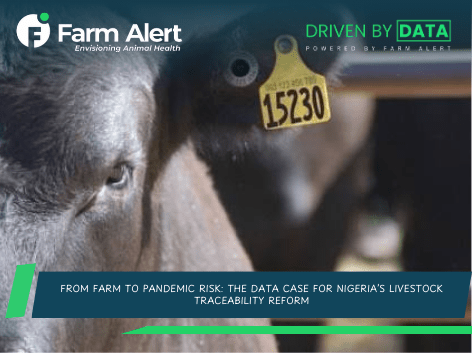
Strengthening livestock traceability is critical for protecting Nigeria’s health and food security
Nigeria’s livestock sector is not a peripheral agricultural activity – it is a strategic economic system and public health vulnerability.
With one of the largest livestock populations in sub‑Saharan Africa, including over 20 million cattle, tens of millions of sheep and goats, and hundreds of millions of poultry birds, livestock contributes significantly to food security, rural employment, and national GDP. Yet structural gaps in disease tracking and movement monitoring create systemic risk. This is where traceability becomes data‑driven risk management infrastructure. (The Nation Newspaper)
Nigeria’s Livestock Import Reality — A Quantified Gap
In parliament in February 2026, Nigeria’s Minister of Livestock Development disclosed that about 65 % of the livestock consumed annually in Nigeria is imported, despite the country’s vast production potential. This stark statistic throws into sharp relief the disconnect between domestic capacity and actual supply dynamics. (ThisDayLive)
This import dependence has also had a long‑term economic cost. Between 2020 and mid‑2025, Nigeria’s livestock import bill climbed to an estimated ₦4.46 trillion, underlining weak domestic investment and structural inefficiencies across production systems. (The Nation Newspaper)
These figures illustrate a clear production deficit that traceability systems could help address by enabling better planning, risk assessment, and investment targeting.
The Missing Infrastructure: Traceability and Disease Control
The National Animal Identification and Traceability System (NAITS) is designed to create unique identification for livestock and digitally track movement, ownership, treatments, and location information throughout the value chain. This extends beyond simple tagging – it creates a real‑time database that can:
• Detect clusters of disease outbreaks
• Support targeted vaccination campaigns
• Monitor medication usage
• Reduce blind spots in cross‑border movement
Such systems are already being piloted at state levels, including in Kogi, where NAITS was launched to improve livestock management, security, and economic viability. (Kogi Flame)
Livestock Movement and Border Health Risks
Unchecked livestock movement across borders is not merely a trade issue – it presents a quantified health risk. Prior government estimates suggested that up to 60 % of cattle entering Nigeria lacked formal health certification, creating pathways for transboundary animal diseases to spread undetected. (Naturenews.africa)
Traceability systems transform these unmonitored movements into data points, reducing uncertainty and supporting faster response if disease threats emerge.
Antimicrobial Use and Digital Accountability
Antimicrobial resistance (AMR) is not an abstract future concern – it is a measurable current threat. Without digital linkage between treatments and specific herds, veterinary antibiotic use remains opaque. A traceability database enables regulators to:
• Track usage patterns per animal or herd
• Flag abnormal prescription volumes
• Link laboratory testing results with treatment history
This level of detail is essential for evidence‑based regulation of veterinary drugs, which remains very weak in the current system.
Economic Losses Without Data
Beyond health, data gaps have measurable economic impacts.
A comprehensive report estimated that ongoing insecurity across Nigeria – which includes livestock theft, rustling, and conflict – has caused up to €4.1 billion in livestock‑related losses, with up to 40 % of livestock deaths attributed to violence and stress factors. (Businessday NG)
These systemic losses can be better understood and mitigated when movement and animal condition data are consistently recorded – the core purpose of traceability.
From Data to Resilience
A fully implemented traceability system should include:
• Forgery‑proof ear tags and digital animal IDs
• Centralized national database with ownership, vaccination, and movement records
• Mobile reporting tools for field capture
• Linkage to laboratory and public health data systems
This would turn livestock tracking into actionable information – the backbone of both disease control and economic planning.
Closing the Gap: Policy and Investment
Nigeria’s livestock sector has the resources to supply its own domestic market and to become a regional exporter. But that requires investment in structural data infrastructure – not just pens and pastures.
Agriculture analysts argue that domestic production could replace a significant share of current imports if supported by modern systems that enable:
• Efficient disease surveillance
• Data‑driven vaccination campaigns
• Organized movement monitoring
• Evidence‑based veterinary regulation
Traceability is more than an agricultural upgrade – it is economic resilience infrastructure.
Conclusion
Nigeria’s livestock system, when mapped and tracked, becomes more than an industry – it becomes an early warning system. With 65 % import dependency, rising livestock imports (₦4.46 trillion over five years), and gaps in disease monitoring, the sector is at a pivotal moment.
Legitimate data – enabled by traceability – will transform livestock from a production puzzle into a predictable contributor to food security, economic growth, and public health resilience.


 farmalert.online
For questions Leave a Reply