
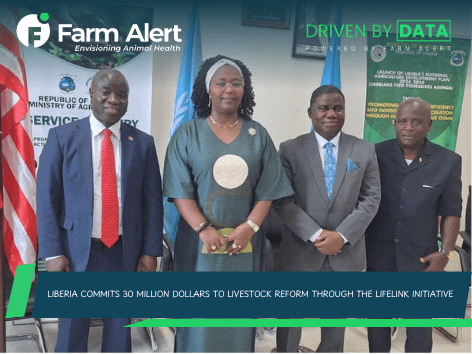
Liberia Launches LIFELINK: A Strategic Shift Toward Livestock Transformation and Meat Independence
Liberia has taken a decisive step toward restructuring and strengthening its livestock sector with the launch of LIFELINK, the country’s first fully dedicated livestock development initiative. More than a sectoral project, LIFELINK represents a structural shift in how Liberia approaches animal agriculture, rural livelihoods, and long-term food security.
Officially launched by Agriculture Minister Dr. J. Alexander Nuetah in partnership with the International Fund for Agricultural Development (IFAD), the project signals a move toward specialized, targeted investment in livestock production systems.
“This is the first time we are moving toward a specialized project focused directly on livestock development,” Dr. Nuetah emphasized during the launch of the strategic design process.
A Turning Point for Liberia’s Livestock Sector
Historically, Liberia’s livestock industry has faced multiple structural challenges, including limited commercial ranch infrastructure, low productivity, inadequate breeding systems, and heavy reliance on meat imports. These factors have constrained domestic supply and exposed the country to international price volatility.
LIFELINK seeks to change that trajectory.
Backed by an initial allocation of US$30 million under IFAD’s 13th replenishment cycle (IFAD 13), the initiative is designed to:
- Revitalize seven ranches across Liberia
- Unlock over 120,000 hectares of grassland in southeastern Liberia
- Expand national cattle production capacity
- Scale up the indigenous Muturu cattle breed
- Strengthen rural income generation and employment
The project reflects a strategic pivot from fragmented livestock support to a coordinated, production-focused development model.
Revitalizing Ranch Infrastructure
A core pillar of LIFELINK is the rehabilitation and modernization of seven ranches across the country. Revitalizing these facilities will create structured production hubs capable of supporting:
- Improved breeding programs
- Animal health management systems
- Feed and pasture development
- Extension services and farmer training
- Value chain linkages
Infrastructure development at this scale is expected to provide a foundation for commercial viability while supporting smallholder integration into formal livestock markets.
Unlocking 120,000 Hectares for Cattle Expansion
One of the most transformative aspects of LIFELINK is the planned utilization of over 120,000 hectares of grassland in southeastern Liberia. This land resource presents significant potential for pasture-based cattle systems, which are well suited to Liberia’s agro-ecological conditions.
Strategic land use planning will be critical to ensure:
- Sustainable grazing management
- Environmental protection
- Conflict-sensitive land governance
- Integration of smallholder producers
If implemented effectively, this expansion could substantially increase domestic beef output and reduce reliance on imported meat.
Scaling the Indigenous Muturu Breed
The project also prioritizes scaling up the Muturu cattle breed, a hardy indigenous West African breed known for its resilience, disease tolerance, and adaptability to tropical environments.
Investing in indigenous genetics aligns with climate-smart livestock development principles. Rather than relying solely on imported breeds that may struggle in local conditions, strengthening Muturu populations could improve productivity while preserving biodiversity and supporting long-term sustainability.
Advancing Meat Independence and Food Security
Liberia currently relies heavily on imported meat products, which exposes consumers to global market fluctuations and foreign exchange pressures. By strengthening domestic cattle production, LIFELINK aims to:
- Improve national protein self-sufficiency
- Reduce import dependency
- Stabilize local meat prices
- Strengthen food security
“This project can mark the beginning of our meat independence,” Dr. Nuetah stated.
Meat independence is not merely an economic objective. It is a food sovereignty and resilience strategy, particularly in a global environment where supply chain disruptions are increasingly common.
Livelihoods, Nutrition, and Economic Resilience
IFAD Country Director Pascaline Barankeba underscored the broader impact of the initiative:
“This is not simply a livestock project. It is a strategic investment in livelihoods, nutrition, and economic resilience.”
Livestock development has multiplier effects across rural economies. Beyond meat production, it stimulates:
- Veterinary services and animal health delivery
- Feed production and agro-input markets
- Processing and cold chain logistics
- Youth employment in agribusiness
- Women’s participation in livestock value chains
By embedding livestock development within a wider rural transformation framework, LIFELINK positions the sector as a driver of inclusive growth.
Timeline and Implementation Outlook
The project is currently entering its strategic design phase, with full implementation expected by the end of 2027 following technical design completion and approval processes.
During this period, key focus areas will include:
- Technical feasibility assessments
- Environmental and social safeguards
- Stakeholder consultations
- Institutional capacity strengthening
- Monitoring and evaluation frameworks
Effective coordination between the Ministry of Agriculture, IFAD, local authorities, and livestock stakeholders will be essential to ensure successful rollout.
A New Era for Liberia’s Livestock Systems
The launch of LIFELINK represents more than the introduction of a new development program. It signals recognition that livestock systems are central to national development, rural prosperity, and food security.
By prioritizing infrastructure rehabilitation, indigenous breed development, pasture expansion, and value chain integration, Liberia is laying the groundwork for a more resilient and productive livestock economy.
If implemented strategically and inclusively, LIFELINK has the potential to redefine the role of livestock in Liberia’s agricultural future and move the country closer to sustainable meat independence.


 farmalert.online
For questions Leave a Reply