
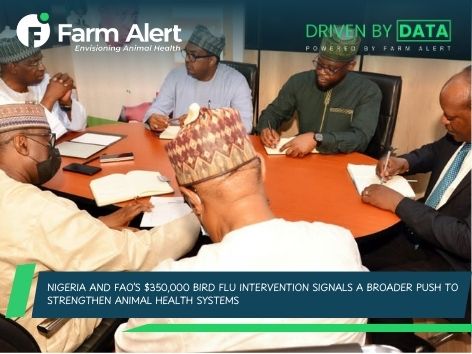
Nigeria has taken another step toward strengthening its livestock disease response through a new partnership with the Food and Agriculture Organization, targeting the ongoing threat of avian influenza and other transboundary animal diseases.
During a strategic meeting held in Abuja on 11 March 2026, Nigeria’s Minister of Livestock Development, Idi Mukhtar Maiha, met with Hussein Gadain, the FAO Representative to Nigeria and ECOWAS, alongside senior officials from the Federal Ministry of Livestock Development and FAO.
The meeting resulted in the approval of an emergency $350,000 Technical Cooperation Programme designed to support Nigeria’s response to Highly Pathogenic Avian Influenza, commonly known as bird flu. The intervention will focus on strengthening disease surveillance, response coordination, and containment efforts in 11 states currently affected by the outbreak.
While the funding itself is relatively modest, the initiative reflects a larger policy shift toward reinforcing veterinary systems as a critical pillar of agricultural resilience and national food security.
A Persistent Threat to Poultry Production
Avian influenza remains one of the most damaging livestock diseases affecting the global poultry sector. Nigeria has experienced repeated outbreaks of the virus since its first major episode in 2006, when the country recorded the first confirmed cases of H5N1 bird flu in Africa.
Since then, periodic outbreaks have continued to affect poultry farms across the country, resulting in the loss of millions of birds and significant economic damage to farmers and the broader poultry industry.
The disease spreads rapidly among poultry populations and can be transmitted through contaminated equipment, wild birds, and live bird markets. In countries where biosecurity measures are weak or unevenly implemented, outbreaks can escalate quickly and spread across large geographic areas.
For Nigeria, where poultry production represents one of the fastest-growing segments of the livestock sector, controlling the disease is essential not only for protecting farmers’ livelihoods but also for maintaining national protein supply.
Strengthening Veterinary Surveillance
The FAO intervention will focus primarily on strengthening Nigeria’s animal health surveillance and response systems.
Effective surveillance is often the first line of defense against transboundary animal diseases. Detecting outbreaks early allows veterinary authorities to implement quarantine measures, trace infection pathways, and limit wider transmission.
According to FAO officials, the programme will support:
- improved disease monitoring and reporting systems
- stronger coordination among veterinary authorities
- technical support for outbreak containment
- enhanced emergency response mechanisms.
These efforts are particularly important in regions where livestock movement, environmental pressures, and production constraints can accelerate the spread of infectious diseases.
Environmental and Structural Risk Factors
During the Abuja meeting, Minister Idi Mukhtar Maiha highlighted several structural factors that are increasing the risk of livestock disease outbreaks across Nigeria.
These include drought conditions, feed scarcity, increased interaction between wildlife and livestock, and extensive cross-border livestock movement. Each of these factors can create pathways for pathogens to circulate between animal populations.
Climate variability, in particular, is emerging as a growing driver of disease dynamics. Changing weather patterns can alter migratory routes for wild birds, influence livestock movement patterns, and stress animal populations, making them more vulnerable to infection.
In such contexts, disease prevention requires not only emergency responses but also long-term investments in veterinary infrastructure.
Beyond Bird Flu: The PPR Eradication Agenda
The meeting also addressed Nigeria’s participation in the global campaign to eradicate Peste des Petits Ruminants, a highly contagious viral disease affecting sheep and goats.
PPR causes severe mortality in small ruminants and poses a major threat to pastoral and smallholder livestock systems across Africa and Asia. The disease is currently targeted for global eradication through an international programme led by the Food and Agriculture Organization and the World Organisation for Animal Health.
To support this effort, Nigeria’s Ministry of Livestock Development plans to convene a national technical meeting to review the country’s eradication strategy and address gaps in vaccine supply.
The National Veterinary Research Institute, Nigeria’s leading veterinary research institution, is expected to play a central role in evaluating vaccine production capacity and supporting national immunization campaigns.
Advancing the One Health Approach
Another key outcome of the meeting was an agreement to accelerate Nigeria’s access to financing under the Pandemic Fund, using a One Health framework.
The One Health concept recognizes that human health, animal health, and environmental systems are closely interconnected. Many emerging infectious diseases originate in animals before spreading to human populations.
Through collaboration with the Nigeria Centre for Disease Control and the Federal Ministry of Health, the government hopes to strengthen national preparedness for zoonotic disease threats.
Such cross-sectoral collaboration is increasingly seen as essential for managing complex health risks that span agricultural and public health systems.
Coordinating International Support
To improve coordination among development partners, the meeting also proposed the establishment of a Livestock Donor Working Group. The platform will help align external funding with Nigeria’s livestock development priorities and reduce fragmentation in international support programmes.
Among the initiatives under discussion is the development of a national feed and fodder strategy, which aims to address chronic feed shortages that constrain livestock productivity across the country.
Looking Ahead
The Abuja discussions are part of a broader effort by Nigeria to modernize its livestock sector and strengthen animal health governance.
Plans are also underway for the Director-General of the Food and Agriculture Organization to participate in an Antimicrobial Resistance Conference scheduled for June 2026 in Abuja, highlighting growing concern over the misuse of antibiotics in both human and animal health systems.
Taken together, these initiatives signal a shift toward more integrated livestock policy, where disease surveillance, veterinary capacity, and international collaboration are viewed as essential components of agricultural transformation.
While the $350,000 FAO intervention is focused on immediate outbreak control, its broader significance lies in reinforcing the systems that protect livestock populations, sustain rural livelihoods, and safeguard the nation’s food supply.


 farmalert.online
For questions Leave a Reply