
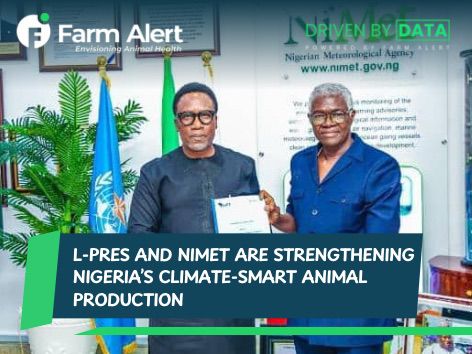
Nigeria’s livestock sector is increasingly confronting a challenge that goes beyond feed availability, disease outbreaks, or market access: climate variability. Rising temperatures, erratic rainfall patterns, and prolonged dry spells are reshaping grazing conditions and livestock productivity across the country. In response, policymakers are beginning to integrate climate intelligence into livestock development strategies.
A recent collaboration between the Livestock Productivity and Resilience Support Project (L-PRES) and the Nigerian Meteorological Agency (NiMet) reflects this shift. The partnership focuses on strengthening weather monitoring systems that can support livestock farmers with reliable climate data and early warnings, enabling them to make better production decisions in an increasingly unpredictable climate environment.
A Strategic Partnership for Climate-Smart Livestock
During a recent engagement between the leadership of L-PRES and NiMet, four Automatic Weather Observation Systems (AWOS) were handed over to NiMet to expand the country’s meteorological monitoring network. These stations will be deployed in rehabilitated grazing reserves to provide localized weather information for livestock production areas.
The initiative is part of broader efforts to improve climate data availability in pastoral and livestock-producing regions. Accurate, real-time weather monitoring allows meteorological agencies to generate more precise forecasts and advisories that farmers can use to manage grazing, water supply, and animal health risks.
For the livestock sector, this type of information is becoming increasingly valuable. Weather patterns influence pasture growth, heat stress in animals, water availability, and the spread of certain livestock diseases. Without reliable climate information, livestock producers often have to rely on guesswork when making management decisions.
The Role of the L-PRES Programme
The Livestock Productivity and Resilience Support Project is a major national initiative supported by the World Bank aimed at transforming Nigeria’s livestock industry. With a financing envelope of approximately $500 million, the programme seeks to modernize livestock production systems while improving resilience to environmental and climate shocks.
The project operates across multiple states and supports several livestock value chains, including cattle, sheep and goats, poultry, pigs, and honey production. Its broader objectives include improving animal productivity, strengthening veterinary and extension services, upgrading livestock infrastructure, and increasing market opportunities for producers.
Climate resilience is a central component of the programme. Nigeria’s pastoral systems depend heavily on natural rangelands, which are particularly vulnerable to changing rainfall patterns and land degradation. By integrating climate information services into livestock development planning, L-PRES aims to help farmers adapt to these challenges while maintaining productivity.
Why Weather Data Matters for Livestock Production
Weather conditions have a direct influence on livestock performance. High temperatures can cause heat stress, which reduces feed intake, lowers milk yield, and affects fertility rates in animals. Drought conditions can diminish pasture availability, forcing farmers to travel longer distances for grazing or rely on expensive feed alternatives.
In addition, weather patterns can influence the spread of livestock diseases. Certain pathogens and parasites thrive under specific environmental conditions, making climate monitoring a useful tool for disease risk prediction.
The Nigerian Meteorological Agency has increasingly focused on delivering climate information tailored to agricultural users. The agency has introduced specialized weather advisories and seasonal forecasts aimed at helping farmers anticipate climate-related risks.
By expanding the national network of automated weather stations through partnerships like the one with L-PRES, NiMet can improve the accuracy of its forecasts and provide location-specific climate insights that are more useful to livestock producers.
The Technology Behind AWOS
Automatic Weather Observation Systems are modern meteorological stations designed to collect and transmit weather data continuously. These systems measure parameters such as temperature, humidity, rainfall, wind speed, and atmospheric pressure.
The data generated by these stations feed into forecasting models used by meteorologists to produce short- and long-term climate predictions. For livestock farmers, access to such data can guide several operational decisions, including grazing schedules, herd movement, and water resource management.
Installing these systems in grazing reserves represents an effort to bridge the gap between national weather forecasts and the specific climate realities faced by pastoral communities.
Strengthening Climate Resilience in Nigeria’s Livestock Sector
Nigeria’s livestock industry supports millions of rural households and contributes significantly to food security. Yet the sector faces mounting pressures from climate change, population growth, and increasing demand for animal protein.
Policy initiatives like L-PRES are therefore focusing on building more resilient production systems that can withstand environmental stress. Investments in veterinary infrastructure, livestock markets, grazing reserves, and climate information services are all part of this broader modernization agenda.
The collaboration with NiMet highlights the growing recognition that climate data is not just relevant for crop farming but also essential for livestock production.
Looking Ahead
As climate risks continue to intensify across the Sahel and West Africa, integrating meteorological intelligence into livestock management may become increasingly critical. Partnerships between agricultural programmes and weather agencies offer a pathway toward more informed decision-making within the livestock sector.
For Nigeria, the L-PRES–NiMet collaboration represents an important step toward climate-smart livestock development. By combining technological innovation with policy support and farmer outreach, such initiatives aim to ensure that livestock producers are better equipped to navigate the environmental uncertainties shaping the future of agriculture.


 farmalert.online
For questions Leave a Reply