
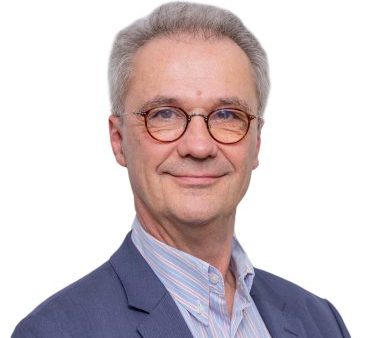
Dr Johan Dreesen takes over from Dr Isabelle Dieuzy-Labaye as GALVmed prepares for its next phase of work on livestock health, vaccination and smallholder livelihoods
The Global Alliance for Livestock Veterinary Medicines (GALVmed) has appointed Dr Johan Dreesen as the new Chair of its Board of Trustees, marking a leadership transition at a time when the organisation is beginning to shape its strategy beyond 2030.
GALVmed announced the appointment on 16 September 2026, with Dreesen taking over from Dr Isabelle Dieuzy-Labaye, who retired as Board Chair on 15 September after four years in the role and eight years on the GALVmed Board.
The appointment comes as GALVmed begins work on its “Beyond 2030” strategy, while also progressing efforts to diversify its funding base and examining future business models that can help the organisation respond to changes in the animal-health sector.
For an organisation whose programmes are increasingly focused on improving access to animal-health products for small-scale livestock producers across Africa, the leadership change comes at a significant point in its development.
Who is Johan Dreesen?
Dreesen brings several decades of experience across veterinary practice, animal-health companies, commercial operations and consultancy.
Before moving into the animal-health industry, he worked in mixed veterinary practices in Belgium and France.
He later held commercial and business-operations positions with major animal-health companies, including Pfizer Animal Health and Zoetis.
More recently, Dreesen has run an animal-health consultancy working with start-ups, animal-health pharmaceutical companies and NGOs. He is also a member of the Advisory Council to Kela Pharma and serves as a Veterinary Expert at the Court of Justice in Brussels.
His relationship with GALVmed is not new.
Dreesen joined the organisation’s Board in March 2023 and has served on its Impact, Monitoring and Evaluation Advisory Committee, Human Resources Committee and Nominations Committee.
His appointment as Chair therefore comes after more than three years of direct involvement with the organisation’s governance and programmes.
A leadership change at a strategic turning point
The timing of the appointment is particularly relevant.
GALVmed is already operating under a 2030 strategy focused on improving access to sustainable livestock vaccines and other animal-health solutions, with Kenya, Tanzania and Nigeria identified as key focus countries.
But the organisation is now beginning to ask what comes next.
GALVmed says its work on a Beyond 2030 strategy is being accompanied by efforts to diversify funding and consider future business models.
These are significant questions for an organisation whose programmes have historically relied substantially on donor funding.
GALVmed says it has received approximately US$300 million in donor funding since 2008 for programmes aimed at improving the livelihoods of small-scale livestock producers by facilitating access to animal-health tools within a sustainable economic framework.
The next phase will therefore involve more than deciding which diseases to target. It will also involve questions around how animal-health products are developed, financed, distributed and ultimately sustained in the markets where livestock producers need them.
VITAL 2 is already shaping the next phase
One of the clearest examples of GALVmed’s current direction is VITAL 2, or Veterinary Innovations Transforming Animal Health and Livelihoods 2.
The programme runs from 2025 to 2030 and builds on GALVmed’s previous VITAL initiative, which supported the development and commercialisation of quality livestock vaccines for small-scale producers.
VITAL 2 is focused particularly on increasing the very low vaccination rates of small and large ruminants across sub-Saharan Africa.
Rather than relying only on traditional public-sector vaccination systems, the programme is designed to strengthen private-sector-driven vaccine markets and improve access to quality vaccines at the last mile.
Its three main areas of work are:
- Enabling the vaccine environment, including strengthening market linkages among manufacturers, governments, private-sector actors and other stakeholders.
- Developing private-sector-driven vaccine supply chains, working both upstream with manufacturers and downstream to improve awareness and access among livestock producers.
- Advancing product development, including work on novel multivalent ruminant vaccines.
The programme is concentrating its initial efforts on Kenya, Tanzania and Nigeria, with the expectation that successful approaches can contribute to wider expansion of private-sector ruminant vaccination beyond these markets and beyond 2030.
Nigeria is one of the programme’s key markets
For Nigeria’s livestock sector, GALVmed’s current direction is particularly relevant.
Nigeria is one of the three countries at the centre of VITAL 2’s implementation strategy.
GALVmed’s broader 2030 strategy identifies Nigeria, alongside Kenya and Tanzania, as a focus country where the organisation intends to demonstrate models of animal-health delivery that can potentially inform wider expansion.
This focus is already visible through work around vaccination markets, veterinary capacity and engagement with animal-health stakeholders.
GALVmed’s current team also includes a Nigeria Country Manager, Dr Moses B. Arokoyo, reflecting the organisation’s established country-level presence.
The organisation is also currently seeking a Strategic Communications Partner for livestock disease prevention and vaccination work in Kenya, Tanzania and Nigeria, further indicating the importance of these markets within its current programme portfolio.
The problem GALVmed is trying to solve is bigger than vaccine availability
Having an effective vaccine does not automatically mean that livestock producers will use it.
A farmer may face challenges finding a veterinary professional, locating an authorised product, paying for the vaccine, transporting animals, accessing cold-chain services or understanding when vaccination should occur.
Manufacturers may also face challenges reaching fragmented rural markets
























Leave a Reply