
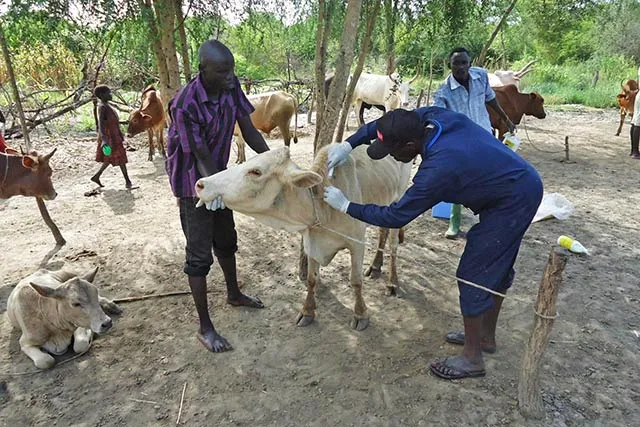
Zambia has vaccinated more than 8,000 livestock against anthrax in Muchinga Province, as authorities intensify disease-control measures following continued wildlife deaths and new human infections in the province.
As of Sunday, 8,233 animals had been vaccinated across Lavushimanda, Mpika and Shiwang’andu districts, according to the Muchinga Provincial Coordinator for the Ministry of Fisheries and Livestock. The campaign has a target of 20,000 animals in the three districts.
The vaccination campaign comes as the outbreak continues to generate concern around Nabwalya Game Management Area in Mpika District, where anthrax has been associated with deaths among wildlife and exposure of people living around the affected areas.
The vaccination numbers
The 8,233 vaccinated animals comprise:
- 6,551 cattle
- 1,324 goats
- 358 sheep
These animals were vaccinated in Lavushimanda, Mpika and Shiwang’andu, three districts included in the targeted response.
The campaign was formally launched on 19 September, with the government initially targeting 20,000 domestic animals in the three Muchinga districts.
At the launch in Mpika, the epicentre of the outbreak response, government officials described vaccination as part of the immediate measures required to protect livestock and prevent the disease from spreading.
But the campaign is not restricted to Muchinga.
The Ministry of Fisheries and Livestock has also dispatched anthrax vaccines to other parts of the country considered affected or at higher risk. According to the Director of Veterinary Services, 600,000 doses were dispatched for mass vaccination campaigns in selected districts.
The reported allocation included vaccines for Southern, Eastern, Western and Muchinga provinces, with vaccination beginning in selected high-risk areas.
Why is Zambia vaccinating livestock when officials say domestic animals have not been affected?
This is one of the most important details in the current response.
Zambia’s veterinary authorities have reported no confirmed anthrax cases in domestic livestock in the affected area at the time of the vaccination campaign.
That means the vaccination programme is primarily a preventive intervention, rather than a response to confirmed widespread infection in cattle, goats or sheep.
This distinction matters because anthrax is an unusual disease from a control perspective.
Bacillus anthracis, the bacterium responsible for anthrax, produces spores that can survive in soil for very long periods. Herbivores can become infected when they ingest spores from contaminated soil, vegetation or other environmental sources.
Where anthrax is present in wildlife, therefore, livestock grazing or moving through the same environment may face a risk even before disease is detected in domestic animals.
That is the logic behind risk-based vaccination: protect susceptible livestock before exposure translates into livestock cases.
The wildlife signal is getting harder to ignore
While livestock vaccination has passed the 8,000-animal mark, wildlife surveillance around Nabwalya continues to identify additional deaths.
The latest assessment has brought cumulative wildlife mortalities associated with the response to 49 hippos, nine elephants and six buffaloes, while the cumulative number of reported human cases has reached 26.
The most recent investigation identified three hippo and two elephant deaths as related to anthrax.
However, it is important to distinguish confirmed findings from suspected deaths.
Earlier in the outbreak, Zambia’s One Health authorities cautioned that not every wildlife death could automatically be attributed to anthrax. Some carcasses could not be sampled because they were inaccessible or already badly decomposed, while laboratory investigations were still ongoing for some species.
That is why continued carcass sampling and laboratory confirmation remain critical.
Why anthrax control is different from many livestock diseases
Anthrax does not behave like a conventional contagious livestock disease.
The bacterium forms highly resistant spores that can remain in the environment for years. When conditions allow susceptible animals to encounter contaminated soil or vegetation, infection can reappear.
This creates a difficult control problem.
Vaccinating cattle, goats and sheep can reduce their susceptibility to disease, but vaccination does not remove the underlying environmental contamination.
That means a successful response also requires:
Vaccination + surveillance + safe carcass disposal + environmental management + community reporting.
WOAH specifically identifies vaccination as an important prevention measure in endemic areas, but also stresses that infected carcasses must be managed carefully because opening a carcass can allow the bacteria to form spores and further contaminate the environment.
The human-health dimension
The current outbreak is also a reminder that anthrax is not only a livestock problem.
Anthrax is a zoonotic disease, meaning people can become infected through contact with infected animals or contaminated animal products. Humans may be exposed while handling carcasses, meat, hides, hair or other animal materials.
In Zambia, authorities have repeatedly warned communities around the affected areas against handling, slaughtering, selling or consuming meat from animals that have died unexpectedly.
The latest investigation also found evidence that some community members had accessed carcass sites, increasing the importance of public awareness and rapid reporting. Authorities are recommending continued community sensitisation to discourage people from opening or consuming carcasses and to encourage immediate reporting of suspected animal deaths.
This is where the veterinary response becomes a public-health response.
A dead animal can represent more than a livestock loss. In an anthrax-affected environment, it can become a source of environmental contamination and a potential exposure point for people, livestock and wildlife.
Why the wildlife–livestock interface matters
The situation in Nabwalya illustrates a challenge facing many African livestock systems: animals do not operate within administrative boundaries.
Livestock may share grazing areas, water sources and landscapes with wildlife. Communities may hunt, handle or consume wildlife. Farmers may move animals through areas where disease has circulated previously.
That creates opportunities for pathogens to move between environmental reservoirs, wildlife, livestock and people.
In Zambia’s current response, this has required multiple institutions to work together.
The recent field investigation involved the Department of National Parks and Wildlife, Ministry of Fisheries and Livestock, Muchinga Provincial Office, the Central Veterinary Research Institute and the Disaster Risk Management Division, alongside laboratory and animal-health teams.
This is essentially a One Health response in practice.
Vaccination is necessary. It is not the entire response.
The progress from zero to more than 8,000 vaccinated animals is significant, particularly against a target of 20,000 in the three affected Muchinga districts.
But vaccination coverage is only one measure of the response.
The next questions are equally important:
Are all animals in the highest-risk areas being reached?
Are newly introduced or moved animals being vaccinated?
Are vaccination records being maintained?
Are suspected animal deaths being reported quickly enough for safe investigation?
Are carcasses being disposed of in a way that prevents further environmental contamination?
Is surveillance continuing around wildlife and livestock contact points?
These questions determine whether a vaccination campaign becomes sustained disease prevention rather than a short-term reaction to an outbreak.
Zambia’s current challenge goes beyond Muchinga
The decision to distribute hundreds of thousands of anthrax vaccine doses to multiple provinces shows that authorities are not treating the problem as a single-location event.
The Ministry of Fisheries and Livestock has urged farmers to cooperate with veterinary teams, make animals available for vaccination and report sudden or unexplained livestock deaths. Farmers have also been warned not to handle or consume meat from animals that die unexpectedly.
That approach is particularly important because anthrax can re-emerge after periods without obvious disease.
WOAH notes that vaccination can prevent outbreaks, but maintaining vaccination in endemic areas is important precisely because environmental spores can persist for long periods.
What Zambia’s response is showing
The latest developments in Muchinga provide several lessons for veterinary disease control.
1. Vaccination can begin before livestock cases become widespread.
Risk-based preventive vaccination can protect susceptible animals when infection is circulating in the surrounding environment.
2. Wildlife surveillance can provide an early warning.
Deaths in wildlife may reveal an environmental disease threat before domestic livestock become affected.
3. Laboratory confirmation matters.
Not every unexplained wildlife death should automatically be classified as anthrax. Sampling and laboratory testing are essential for determining where the disease is actually present.
4. Carcass management is disease control.
With anthrax, what happens to a carcass can influence what happens next. Safe disposal and prevention of human and animal access are fundamental to limiting further contamination.
5. Veterinary response and public-health response cannot be separated.
With 26 reported human cases alongside continuing animal mortalities, the outbreak demonstrates why veterinary, wildlife and human-health authorities need to operate as one surveillance and response system.
The vaccination campaign is now a race against exposure
Zambia has moved more than 8,000 animals through its Muchinga vaccination campaign, with almost 12,000 animals still remaining to reach the provincial target of 20,000.
At the same time, authorities are still investigating new wildlife mortalities and monitoring human cases.
The immediate objective is therefore not simply to vaccinate a number of animals. It is to build enough protection around livestock populations while surveillance identifies where the environmental risk remains active.
Anthrax is difficult precisely because the disease can disappear from view while its spores remain in the environment.
For Zambia, the current response is therefore about more than the number of vaccines administered.
It is about whether vaccination, surveillance, laboratory investigation, carcass management and community reporting can work together quickly enough to break the pathway from environment to wildlife, wildlife to livestock, and livestock or wildlife to people.
The latest vaccination figures show that the response is moving.
The continuing wildlife deaths show why it cannot stop there.























Leave a Reply