
For nearly two decades, Kenya’s veterinary profession has been waiting for a remuneration decision that began with a government job evaluation in 2007.
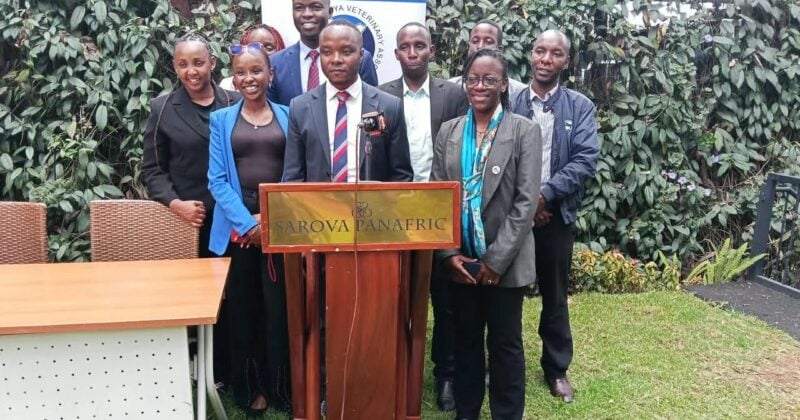
Now, the Kenya Veterinary Association (KVA) has taken the matter back to Parliament, asking lawmakers to address what it describes as a longstanding disparity between the pay and allowances of veterinary doctors and those of medical doctors.
But the dispute raises a question that extends well beyond salaries:
What does it cost a country when the workforce responsible for protecting its animals, livestock economy and public health is not adequately supported?
The issue is particularly significant at a time when Veterinary Services are being asked to manage increasingly complex disease threats, from transboundary animal diseases and zoonoses to antimicrobial resistance, food-safety risks and the effects of climate change.
A dispute that began in 2007
KVA President Dr Kelvin Osore told the National Assembly Departmental Committee on Labour that the association has been pursuing harmonisation of veterinary remuneration since a 2007 job evaluation by the Ministry of Public Service.
According to KVA’s submission, the National Treasury subsequently allocated KSh449 million annually in 2017 towards the proposed harmonisation, but the arrangement was not implemented. The Parliamentary Committee has now said it will investigate what happened to the earlier proposal and who was responsible for its implementation.
The issue formally reached the National Assembly in August 2026, when Speaker Moses Wetang’ula conveyed a petition from KVA seeking harmonisation of the salaries and allowances of veterinary doctors and veterinary interns with those of medical doctors.
Nineteen years after the original job evaluation, the matter is therefore back before lawmakers.
The numbers behind the dispute
One of KVA’s most striking concerns is the remuneration of veterinary interns.
The association says veterinary interns receive about KSh27,000 per month, while medical interns receive approximately KSh180,000 to KSh208,000, and is asking Parliament to harmonise the veterinary internship stipend. These are figures presented by KVA in its case to Parliament, rather than independently established salary scales for every intern category.
The internship is not optional. Kenya’s veterinary regulatory framework requires graduates to complete a supervised internship before full professional registration.
That makes the remuneration question particularly important.
A graduate cannot simply bypass the internship and enter independent practice. Yet the financial conditions attached to this mandatory transition into the profession can influence who is able to enter, where graduates are willing to train and whether they pursue public-sector veterinary careers.
For a country trying to maintain veterinary capacity across rural communities, livestock-producing areas, laboratories, border points and disease-control programmes, that becomes a workforce-planning issue.
What KVA is asking for
KVA’s demands extend beyond basic salary harmonisation.
The association has asked for a KSh50,000 monthly health-risk allowance, a non-practice allowance ranging from KSh12,000 to KSh60,000 depending on job group, a KSh40,000 extraneous allowance, KSh20,000 call allowance, KSh10,000 uniform allowance and KSh20,000 Health Workers Service Allowance for veterinary doctors.
The association argues that veterinary professionals operate in uncontrolled field environments and face occupational exposure to hazards including rabies, anthrax, Rift Valley fever and severe animal trauma.
The argument is therefore not simply that veterinary professionals should receive the same salaries as another profession.
It is that the structure of remuneration should recognise the responsibilities and risks attached to Veterinary Services.
Why veterinary remuneration is an animal-health issue
This is where the Kenyan dispute becomes bigger than a labour story.
A veterinary workforce is part of a country’s disease-control infrastructure.
Veterinarians and veterinary paraprofessionals support surveillance, vaccination, outbreak investigation, laboratory systems, animal movement controls, food inspection, zoonotic-disease prevention and disease-response operations.
When those functions work well, many of the benefits are invisible.
A disease is detected early.
An outbreak is contained before it spreads.
A contaminated food product is stopped from reaching consumers.
A livestock market remains open.
A farmer does not lose an entire herd.
A zoonotic disease is prevented from becoming a human-health emergency.
The economic value of Veterinary Services therefore extends far beyond the consultation fee paid for treating an individual animal.
Kenya’s own parliamentary proceedings underline this broader role. KVA has pointed to the importance of veterinary professionals to animal disease control, food safety and the livestock economy.
Kenya’s livestock economy makes the workforce question bigger
The stakes are particularly high in Kenya because livestock is deeply integrated into rural livelihoods and the national economy.
Figures presented in connection with the KVA petition put livestock’s contribution at approximately 42% of agricultural GDP and 12% of national GDP, while more than 10 million people in arid and semi-arid areas depend substantially on livestock for their livelihoods.
That means veterinary workforce capacity has implications far beyond the profession.
If disease surveillance weakens, the consequences can move from farms into markets.
If disease-control programmes slow down, production losses can rise.
If food-safety oversight is inadequate, risks can move further along the food chain.
And if transboundary animal diseases become established, restrictions on livestock movement and trade can impose costs well beyond the veterinary budget.
This is why workforce investment is better understood as part of economic and food-system resilience.
Kenya is not the only African country facing the problem
Kenya’s experience also reflects a wider challenge across Africa: countries may have veterinary graduates, but struggle to retain enough professionals in the public system and in the places where they are most needed.
Ghana provides a useful comparison.
A 2025 report on Ghana’s veterinary workforce described low remuneration and limited professional incentives as contributing to a brain drain. It reported that more than 35 veterinary doctors left Ghana for opportunities abroad between 2022 and 2024, while about 68 young veterinary doctors remained on government payroll performing functions across district and regional clinics, entry points, farms and laboratories.
Ghana’s situation is not identical to Kenya’s, and the figures come from reporting on the country’s veterinary workforce rather than a directly comparable official workforce dataset.
But the two cases point towards the same policy problem:
Training veterinarians is only one part of building Veterinary Services. Keeping them in the system is another.
A country can continue producing graduates while simultaneously losing experienced professionals through migration, retirement, resignation or movement into better-paying sectors.
The result can be a veterinary workforce that exists numerically but lacks sufficient distribution, experience or specialist capacity.
The global picture is even more revealing
The World Organisation for Animal Health (WOAH) has now put veterinary workforce capacity at the centre of its global animal-health investment argument.
Its 2026 State of the World’s Animal Health report found that although 95% of assessed Members maintained or improved their capacity for continuing veterinary education, 18% reported declining veterinarian capacity and 22% reported declining veterinary-paraprofessional capacity.
That distinction is important.
The problem is not simply whether countries have veterinary schools or whether professionals are receiving some form of training.
It is whether Veterinary Services have enough people, with the right skills and institutional support, to perform the functions expected of them.
WOAH estimates that bringing Veterinary Services assessed through its Performance of Veterinary Services framework up to international standards would require approximately US$2.3 billion in additional investment each year. At the same time, development assistance for Veterinary Services remains below US$1 billion annually.
The organisation also reports that animal health receives as little as 0.6% of global health spending.
The implication is clear: the workforce problem is part of a much larger financing gap.
The cost of underinvestment is not always visible immediately
There is an important difference between paying for Veterinary Services and paying for the consequences of weak Veterinary Services.
The first appears as a budget line.
The second can appear as livestock deaths, emergency vaccination campaigns, trade restrictions, food losses, zoonotic disease outbreaks and reduced household income.
WOAH estimates that animal diseases destroy more than 20% of global animal production each year, illustrating the scale of losses that animal-health systems are expected to prevent.
This does not mean every disease loss can be attributed to inadequate staffing or remuneration.
It does, however, demonstrate why the capacity of Veterinary Services matters economically.
The question for governments is therefore not simply how much veterinary professionals cost.
It is also how much it costs when there are too few of them, when they are poorly distributed or when experienced professionals leave the system.
The rural workforce question
For Kenya and many other African countries, remuneration also intersects with geography.
A veterinarian working in a major city and a veterinarian deployed to a remote livestock-producing region may face very different working conditions.
Remote deployment can involve long distances, difficult roads, limited equipment, exposure to disease and animal-related hazards, and fewer opportunities for professional development.
A salary package that looks reasonable on paper may therefore be inadequate for retaining professionals in areas where the veterinary need is greatest.
This is why workforce policy cannot stop at basic salary.
It has to consider deployment incentives, housing, transport, equipment, professional development, safety and career progression.
The objective should be to make it possible for Veterinary Services to place professionals where disease risk and livestock populations demand them, rather than where working conditions happen to be easiest.
The internship question deserves particular attention
Kenya’s dispute over veterinary interns may ultimately prove to be one of its most consequential elements.
Internships are the bridge between university training and independent professional practice.
If veterinary graduates are required to complete this period before registration, then the internship system is effectively part of the country’s veterinary workforce pipeline.
That means governments have an interest in making it functional.
The question is not simply whether an intern deserves a particular stipend. It is whether the internship system can reliably produce competent professionals and retain enough of them for public Veterinary Services.
If the financial burden becomes too high, the profession risks becoming less accessible to graduates without independent financial support.
That is a workforce issue before it becomes a salary issue.
What Kenya’s Parliament is now being asked to resolve
The National Assembly’s Labour Committee has said it will examine why previous remuneration proposals were not implemented and seek evidence from relevant government institutions.
That investigation could provide something more valuable than a simple decision on allowances.
It could give Kenya an opportunity to examine its veterinary workforce as a system:
- How many veterinarians does the country actually need?
- Where are the biggest staffing gaps?
- How many professionals are leaving public service?
- Which incentives are effective in retaining veterinarians in underserved areas?
- What does the country spend on prevention compared with outbreak response?
- And what level of veterinary capacity is required to protect Kenya’s livestock economy and public health?
Those are questions other African countries could ask themselves too.
The bigger lesson for Africa
Kenya’s 19-year dispute is ultimately a reminder that Veterinary Services do not run on qualifications alone.
They require people.
They require laboratories, surveillance networks, medicines, vaccines, transport and equipment. But all of those systems still depend on professionals capable of operating them.
WOAH’s latest global assessment makes this explicit: shortages in the veterinary workforce, including gaps in numbers, skills, regulatory capacity and professional independence, represent a significant risk to animal-health systems.
For African countries facing recurrent outbreaks of FMD, PPR, rabies, anthrax, Rift Valley fever and other diseases, the question is therefore bigger than whether veterinary professionals are paid competitively with other health workers.
It is whether governments are investing enough in the people who make disease prevention possible.
Kenya’s Parliament now has an opportunity to turn a 19-year remuneration dispute into a broader examination of veterinary workforce policy.
After nearly two decades, the country is no longer simply being asked to settle a salary disagreement.
It is being asked to decide how much value it places on the Veterinary Services protecting its animals, food systems, economy and people.


























Leave a Reply