
By Rodiyah Adegoke
Over the past two years, South Africa has confronted a significant and sustained outbreak of Foot‐and‐Mouth Disease (FMD) – a highly contagious viral disease of cloven-hoofed animals – with far-reaching impacts on agricultural productivity, export markets, rural livelihoods, and national food security. This post provides a comprehensive, data-rich exploration of the outbreak’s evolution, economic consequences, response measures, and implications for the future.
What Is Foot-and-Mouth Disease?
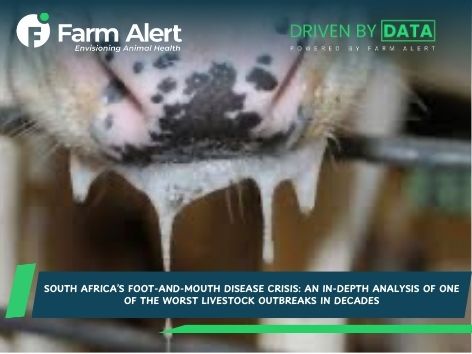
Foot-and-Mouth Disease (FMD) is caused by an aphthovirus that affects cattle, sheep, goats, pigs, and other cloven-hoofed animals. While rarely fatal in adult animals, the disease causes fever, vesicles (blisters) in the mouth and hooves, lameness, reduced feed intake, and drastic drops in productivity. FMD spreads rapidly between animals via direct contact, aerosols, fomites, and animal movements.
Timeline: From Early 2025 to Present
Outbreak Emergence
- The outbreak was first confirmed in the Free State province on 10 July 2025 on a commercial farm in the Moqhaka Local Municipality, triggering immediate quarantine and control efforts.
- By late 2025, the disease had spread extensively. Estimates suggest more than 24,400 reported FMD cases in 2025 alone, far exceeding the previous 20-year high of approximately 7,700 in 2022.
- Records from mid-year indicated outbreaks in eight of South Africa’s nine provinces, leaving only the Northern Cape comparatively unaffected.
Spread and Case Data
- In North West province, authorities reported 138 confirmed cases as of 19 February 2026 – 135 in cattle, two in pigs, and one in goats – across 16 of 18 municipalities.
- Earlier reporting from 2025 highlighted multiple outbreaks in KwaZulu-Natal and Eastern Cape, with dozens of active foci across farms and dip tanks.
Economic Consequences: Exports, Production, and Revenue Losses
The economic toll of the FMD outbreak has been severe and multifaceted, striking both domestic producers and South Africa’s position in global markets.
Export Disruptions
- South African beef exports for the first 11 months of 2025 fell to ~24,773 tons, a sharp reduction from 38,677 tons in the same period of 2024.
- The outbreak triggered export bans and restrictions from key markets. Fully closed destinations include China, Eswatini, Mozambique, Zimbabwe, and Namibia, while others (e.g., certain Middle Eastern countries) imposed partial restrictions requiring product treatment guarantees.
- Beef shipments to China – historically one of South Africa’s major markets – fell by roughly 69% in 2025, contributing to a 26% national decline in beef exports year-on-year.
Lost Export Revenue
- Government figures estimate the outbreak has cost the livestock sector approximately R5.6 billion in export earnings due to closures and restrictions on beef, goat/sheep meat, and live animals.
- Fresh and frozen beef: ≈ R3.7 billion
- Goat and sheep meat: ≈ R1.4 billion
- Live cattle, sheep and goat exports: ≈ R502 million
Long-Term Projections
- Economic modelling by the Bureau for Food and Agricultural Policy (BFAP) warns that cumulative FMD impacts between 2025 and 2030 could reach:
- ~R3.2 billion under a medium-burden scenario
- ~R11.3 billion under a high-burden scenario for the beef industry alone.
- BFAP also estimates total beef industry output losses could accumulate to R25.6 billion over the next decade, when considering reduced production volumes, lower calf supplies, and export pressures.
Sectoral Impacts: Dairy, Rural Economies, and Prices
Dairy Sector Strain
- FMD has significantly affected the dairy industry: with over 90 dairy farms impacted by mid-January 2026, involving an estimated 210,000 dairy animals.
- Losses to the dairy sector have already exceeded R1 billion, with per-cow losses in some regions approaching R5,000 due to reduced milk yields, veterinary costs, and additional husbandry needs.
- BFAP warned that these pressures could push some dairy operations to closure, threatening rural jobs and service sectors in affected areas.
Domestic Slaughter and Prices
- Data suggests a moderate decline in domestic slaughter figures: approximately 218,000 cattle slaughtered per month in 2025 compared with 235,000 monthly in 2024.
- Producer prices have adjusted downward, with average Class A beef prices dropping from around R83/kg in mid-2025 to ~R65/kg by the end of the year.
Government and Industry Response
Vaccine Strategy and Supply
- In February 2026, South Africa received an initial shipment of 1 million high-potency FMD vaccine doses to strengthen proactive disease management.
- Partnership with the Botswana Vaccine Institute (BVI) has supplied over 2 million doses to date, with continued monthly deliveries.
- Significantly, the Agricultural Research Council (ARC) restarted domestic FMD vaccine production for the first time in over 20 years:
- The first 12,900 doses were produced in early 2026.
- Weekly output is set to scale from ~20,000 doses to 200,000 doses per week by 2027, as facilities expand.
- This resumption marks a strategic shift towards vaccine sovereignty and greater self-reliance, reducing dependence on imported stocks from Botswana, Argentina, and Turkey.
Policy and Coordination
- Authorities have moved toward proactive vaccination campaigns, emphasizing herd immunisation rather than reactive outbreak responses.
- Control measures include surveillance, movement restrictions, quarantine zones, and animal identification systems to improve tracking and containment.
- The South African government, industry bodies, and producer organisations continue to collaborate on enforcement of biosecurity protocols and livestock movement compliance.
Broader Sector Challenges and Outlook
Trade and Reputation Risks
- Repeated export disruptions are eroding South Africa’s credibility as a reliable livestock trading partner, potentially affecting long-term market access.
Farmer and Industry Concerns
- Some producer groups have criticised the government response as slow and fragmented, and legal action has been threatened to compel more decisive action.
- Rising production costs, veterinary expenses, and long-term herd health challenges continue to strain small and commercial operations alike.
Conclusions
South Africa’s FMD outbreak underscores the complexity of managing transboundary animal diseases in modern agricultural economies. With tens of thousands of cases reported, multi-billion rand revenue losses, and extensive export market disruption, the crisis is not merely an animal health concern but a national economic challenge requiring sustained investment, strategic vaccination, and strengthened biosecurity infrastructure.
While recent developments – such as domestic vaccine production and coordinated national vaccination plans – offer hope, the path to restoring market confidence, protecting rural livelihoods, and achieving long-term disease control will require continued commitment across government, industry and producer communities.


 farmalert.online
For questions Leave a Reply