
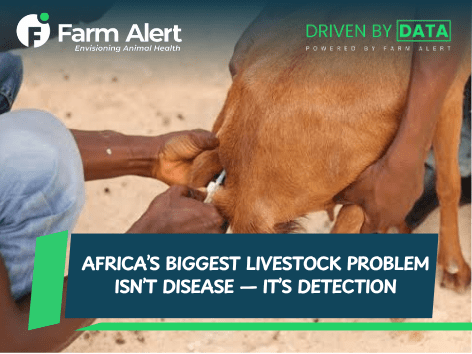
Across Africa, livestock diseases are not new.
Outbreaks of Foot-and-Mouth Disease, Peste des Petits Ruminants, and Contagious Bovine Pleuropneumonia have been recorded for decades. Farmers are familiar with the symptoms. Governments are familiar with the response.
Yet, despite this familiarity, the economic and production losses remain persistently high.
The question is no longer whether Africa understands livestock diseases.
The real question is whether Africa is detecting them early enough.
The Silent Gap in Animal Health Systems
In many African countries, disease response is still largely reactive.
Animals fall sick. Symptoms become visible. Mortality begins to rise. Only then does intervention start.
By that point, the damage is already done.
This delay is not always due to negligence. It is often the result of a deeper structural issue. Limited access to diagnostic tools, weak laboratory networks, and fragmented surveillance systems continue to slow down early detection.
Recent developments in countries like Kenya highlight this gap clearly. Veterinary stakeholders have identified diagnostics as one of the weakest links in the livestock value chain, particularly for smallholder farmers who form the backbone of production.
Without timely and accurate diagnosis, treatment becomes guesswork, outbreaks spread faster, and productivity declines.
Why Detection Matters More Than Treatment
The economics of livestock disease control are straightforward.
Detect early, and the cost of control is low.
Detect late, and the cost multiplies across the system.
A single undetected outbreak can:
- spread across herds and communities
- reduce milk and meat productivity
- trigger trade restrictions
- increase mortality rates
In countries with large livestock populations, the impact is even more significant. For instance, Nigeria, with over 50 million cattle, faces recurring outbreaks of diseases like Contagious Bovine Pleuropneumonia, affecting multiple states simultaneously.
In such contexts, detection is not just a technical issue. It is an economic one.
A Shift Is Beginning, Quietly
April 2026 has revealed a subtle but important shift.
Across the continent, there is growing recognition that strengthening veterinary systems must begin with improving detection.
In East Africa, investments are being directed toward:
- expanding diagnostic laboratories
- improving access to testing for farmers
- strengthening disease surveillance networks
At the same time, digital tools are beginning to play a role. Traceability systems, animal identification technologies, and data-driven platforms are gradually being introduced to monitor animal health more effectively.
These developments may not attract headlines, but they represent a foundational change in how animal health systems operate.
The Role of Veterinarians Is Changing
As detection becomes more central, the role of veterinarians is also evolving.
Beyond clinical care, veterinarians are increasingly expected to:
- interpret diagnostic data
- contribute to surveillance systems
- support early warning mechanisms
- guide preventive strategies
This shift requires new skills and new approaches.
Veterinary practice is no longer confined to treating individual animals. It is becoming part of a broader system focused on managing population health.
The Cost of Ignoring Detection
Failure to address the detection gap has long-term consequences.
Delayed diagnosis allows diseases to become endemic. It reduces the effectiveness of vaccines and treatments. It weakens confidence in veterinary services.
More importantly, it limits Africa’s ability to participate in global livestock markets.
International trade increasingly depends on traceability, transparency, and disease control. Without strong detection systems, meeting these standards becomes difficult.
A Systems Problem, Not Just a Technical One
Improving detection is not simply about building more laboratories.
It requires:
- coordinated national surveillance systems
- trained veterinary personnel
- accessible diagnostic services for farmers
- integration of data across regions
It is, fundamentally, a systems challenge.
And systems take time, investment, and coordination to build.
Looking Ahead
The narrative around livestock diseases in Africa is slowly changing.
The focus is shifting from reacting to outbreaks to preventing them. From treating symptoms to understanding causes. From isolated interventions to coordinated systems.
This shift is still in its early stages, but it is a necessary one.
Because in the end, controlling livestock diseases is not just about having the right treatments.
It is about knowing, early enough, when and where to use them.
Final Thought
Africa does not lack knowledge of livestock diseases.
What it has lacked is the ability to detect them early, consistently, and at scale.
Until that gap is closed, outbreaks will continue to outpace interventions.
And the true cost will continue to be paid not just in animal health, but in livelihoods, food security, and economic growth.


 farmalert.online
For questions Leave a Reply