
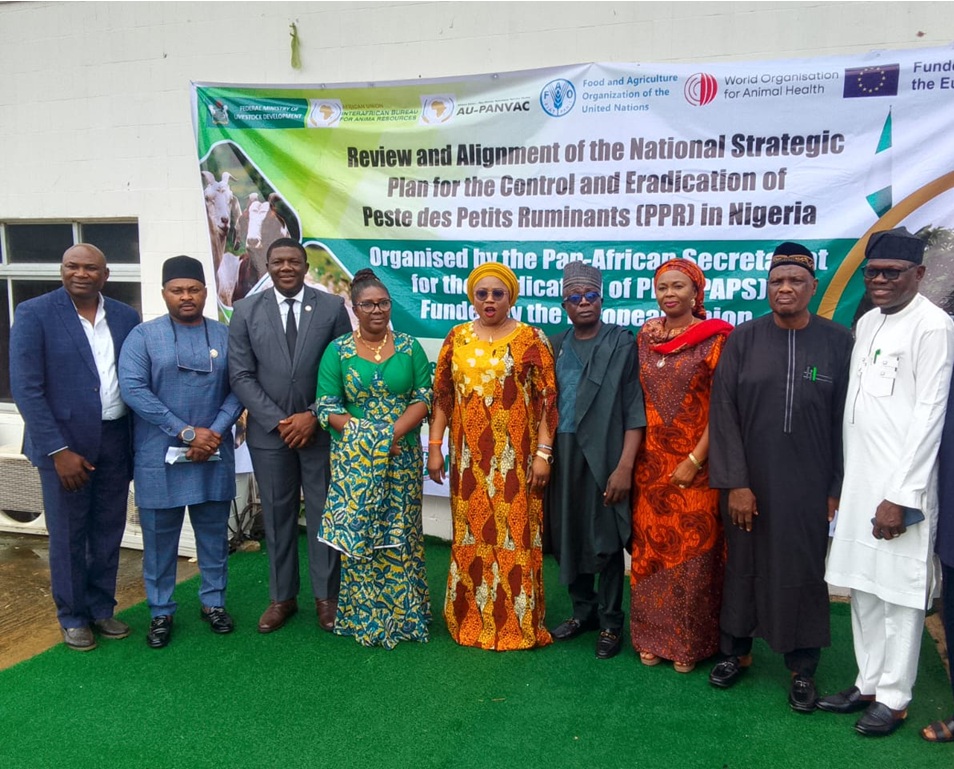
When news broke that a delegation from the African Union Inter-African Bureau for Animal Resources (AU-IBAR) had arrived in Abuja on 20 July 2026 for a Peste des Petits Ruminants (PPR) eradication readiness mission, it would have been easy to dismiss it as another routine diplomatic visit.
It was anything but.
Behind the official meetings lies a much bigger story. One that speaks to the future of Nigeria’s livestock industry, the resilience of millions of rural households and Africa’s determination to eliminate one of the continent’s most destructive animal diseases.
The visit comes at a time when Nigeria is undertaking some of the most ambitious reforms its livestock sector has seen in decades. The establishment of the Federal Ministry of Livestock Development, the launch of the 10-Year National Roadmap for Veterinary Services (2026–2036), investments in vaccine production and cold chain infrastructure, and ongoing efforts to modernise livestock data systems all point to one reality.
Nigeria is no longer thinking only about livestock production.
It is beginning to think about livestock resilience.
The AU-IBAR mission is one more indication that Africa is watching.
The disease that quietly costs Africa billions
Peste des Petits Ruminants, commonly known as PPR or goat plague, rarely makes headlines outside veterinary circles. Yet it remains one of the most economically damaging livestock diseases affecting developing countries.
The disease attacks sheep and goats, causing high fever, severe eye and nasal discharge, mouth lesions, diarrhoea and pneumonia. In populations with little or no immunity, outbreaks can kill more than 80 percent of infected animals within a short period.
There is no cure.
For livestock owners, that often means watching years of investment disappear within days.
While the biological impact of the disease is severe, its economic consequences are even greater.
Across Nigeria, sheep and goats are more than livestock. They are savings accounts on four legs.
A family may sell a goat to pay school fees. A widow may depend on a small flock as her primary source of income. A young farmer may build an entire enterprise by gradually expanding a handful of breeding animals. During periods of crop failure or unexpected medical expenses, small ruminants often become the first line of financial security.
When PPR sweeps through a community, it destroys much more than animals.
It erodes household wealth, weakens food security, disrupts local markets and pushes vulnerable families further into poverty.
This is why the fight against PPR has become as much an economic priority as it is a veterinary one.
Why eradication is no longer an impossible dream
Unlike many transboundary animal diseases, PPR possesses characteristics that make complete eradication scientifically achievable.
There is only one serotype of the virus, meaning vaccines developed against it provide broad protection. Highly effective vaccines are already available and can provide long-lasting immunity. Unlike diseases sustained by complex wildlife reservoirs, PPR transmission can be interrupted through well-coordinated vaccination and surveillance programmes.
These scientific advantages led the Food and Agriculture Organization (FAO) and the World Organisation for Animal Health (WOAH) to launch the Global Programme for the Control and Eradication of PPR, with the goal of eliminating the disease worldwide.
Africa, home to one of the world’s largest populations of sheep and goats, sits at the heart of that ambition.
That explains why AU-IBAR’s role has become increasingly important.
More than another African Union agency
Outside professional veterinary circles, AU-IBAR remains relatively unknown.
Yet the institution has become one of the African Union’s most influential technical agencies for animal health and livestock development.
Its responsibilities extend far beyond policy coordination.
AU-IBAR supports countries in strengthening veterinary governance, improving laboratory systems, enhancing disease surveillance, coordinating cross-border disease control, developing regional livestock policies and mobilising resources for disease eradication programmes.
It also hosts the Pan-African PPR Secretariat, the body responsible for coordinating Africa’s implementation of the continental eradication strategy.
Viewed from that perspective, the delegation’s arrival in Abuja represents something significant.
It is a readiness assessment.
Not simply of Nigeria’s vaccination campaigns, but of the country’s entire veterinary system.
Readiness cannot be measured by vaccines alone
One of the biggest misconceptions surrounding disease eradication is the belief that success depends solely on the availability of vaccines.
Vaccines are essential.
They are not enough.
Successful eradication begins long before a vaccine reaches an animal.
Veterinarians must detect outbreaks early.
Laboratories must confirm infections quickly.
Cold chain systems must keep vaccines potent from production facilities to remote communities.
Extension workers must educate livestock owners.
Digital reporting systems must identify emerging hotspots before outbreaks spread.
Governments must sustain funding even when disease cases begin to decline.
Each component depends on the others.
A failure in one part of the system weakens the entire programme.
This systems approach explains why Nigeria recently convened stakeholders to review and strengthen its National Strategic Plan for PPR eradication. Discussions extended beyond vaccination targets to include epidemiological surveillance, laboratory diagnostics, risk mapping, monitoring frameworks and alignment with international assessment tools such as the Progressive Control Pathway for PPR.
The objective is clear.
Move from responding to outbreaks to preventing them altogether.
Nigeria’s livestock reforms are changing the conversation
The AU-IBAR mission did not occur in isolation.
It forms part of a broader transformation taking place within Nigeria’s livestock sector.
For decades, conversations around livestock largely focused on increasing production.
Today, the agenda is becoming more sophisticated.
The creation of the Federal Ministry of Livestock Development marked a major institutional shift, recognising livestock as a strategic contributor to national economic development, food security and export potential.
The launch of the National Roadmap for Veterinary Services has similarly placed renewed emphasis on strengthening veterinary governance, workforce capacity and disease surveillance over the next decade.
At the same time, the nationwide livestock baseline study promises to generate more reliable data for planning vaccination campaigns, allocating resources and monitoring disease trends.
The National Digital Farmer Registry is also helping lay the foundation for more targeted livestock interventions by improving traceability and strengthening engagement with livestock producers.
Taken together, these reforms signal an important change in thinking.
Modern livestock development is no longer measured solely by the number of animals a country owns.
It is increasingly measured by how effectively those animals are protected.
Vaccines save lives. Systems deliver impact.
Nigeria’s investments in vaccine infrastructure further reinforce this transition.
Recent improvements supported under the Livestock Productivity and Resilience Support (L-PRES) programme include the commissioning of a solar-powered vaccine cold chain facility in Adamawa State, designed to strengthen storage and distribution across the region.
At the same time, efforts are underway to expand the National Veterinary Research Institute’s annual vaccine production capacity from approximately 150 million doses to an estimated 850 million doses.
These investments are significant.
Yet producing vaccines is only half the challenge.
Vaccines that fail to reach livestock keepers on time offer little protection.
Maintaining cold chain integrity, improving last-mile delivery, ensuring adequate veterinary personnel and building trust within livestock communities ultimately determine whether vaccines translate into healthier animals.
Disease eradication is therefore not simply a manufacturing challenge.
It is a logistics challenge.
It is a governance challenge.
It is a public health challenge.
Why regional cooperation matters
Nigeria cannot eradicate PPR on its own.
Every day, thousands of livestock move across borders linking Nigeria with Niger, Chad, Cameroon and Benin.
Animals do not recognise immigration checkpoints.
An outbreak contained within one country today can quickly become a regional problem tomorrow.
This reality explains why AU-IBAR places such strong emphasis on harmonised surveillance systems, coordinated vaccination campaigns and regional information sharing.
Disease eradication succeeds only when neighbouring countries move together.
In many respects, PPR control is as much about diplomacy as it is about veterinary science.
What success would really look like
A PPR-free Nigeria would represent far more than the elimination of a livestock disease.
It would mean fewer economic shocks for rural households.
More reliable incomes for livestock farmers.
Greater confidence for investors entering the livestock value chain.
Improved regional trade opportunities.
Stronger food security.
More resilient veterinary institutions capable of responding to future disease threats.
Perhaps most importantly, it would demonstrate that sustained investment in veterinary systems delivers measurable national development outcomes.
Too often, veterinary services are viewed only through the lens of animal treatment.
In reality, they underpin agricultural productivity, public health, economic resilience and national food systems.
A moment worth paying attention to
The arrival of AU-IBAR’s delegation in Abuja may never dominate newspaper front pages.
Yet history is often shaped by moments that initially appear ordinary.
Africa has already developed the science needed to eliminate PPR.
Effective vaccines exist.
Proven surveillance frameworks are available.
Regional coordination mechanisms are becoming stronger.
Countries like Nigeria are investing in veterinary infrastructure at a scale rarely seen before.
The question is no longer whether eradication is technically possible.
The question is whether countries can sustain the political commitment, financing and institutional capacity required to turn ambition into reality.
If Nigeria succeeds, the benefits will extend far beyond healthier sheep and goats.
It will strengthen rural livelihoods, improve food security, expand trade opportunities and reinforce confidence in the country’s evolving livestock sector.
Seen from that perspective, AU-IBAR’s visit was never just another official engagement.
It was a reminder that the future of livestock development in Africa will not be determined by declarations alone.
It will be determined by the strength of the veterinary systems built today, the partnerships forged across borders and the commitment to ensure that diseases like PPR become part of history rather than a recurring threat to the continent’s farmers.

























Leave a Reply