
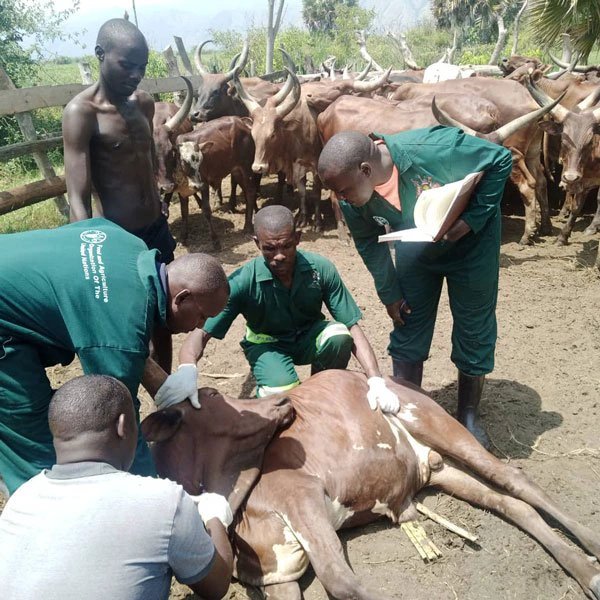
After more than 87 cattle were lost to Foot-and-Mouth Disease, Namisindwa District has lifted its quarantine. But livestock movement will remain tied to proof of vaccination.
Namisindwa District in eastern Uganda has lifted a Foot-and-Mouth Disease (FMD) quarantine that had been in place since July, following a reported reduction in disease cases.
The quarantine, imposed on 15 July 2026, was lifted effective 8 September, following an assessment by the District Veterinary Office which found an improvement in the FMD situation across the district. However, the end of the quarantine does not mean that disease-control measures have ended.
Under the new movement requirements, livestock owners and traders must provide valid FMD vaccination cards for animals being moved to other sub-counties or districts or taken to livestock markets. Animals without valid vaccination documentation will not be permitted to move or enter livestock markets.
The decision comes after Namisindwa reportedly lost more than 87 cattle to FMD before the quarantine was imposed, highlighting the cost of an outbreak that extends beyond animal health to farmers, livestock traders and local markets.
For Uganda, the development represents more than the reopening of a district after an outbreak. It provides a practical example of how vaccination, veterinary certification and livestock movement controls can work together to contain transboundary animal diseases.
What is Foot-and-Mouth Disease?
Foot-and-Mouth Disease is a highly contagious viral disease affecting cloven-hoofed animals, including cattle, pigs, sheep, goats and several wild animal species.
The disease is caused by Foot-and-Mouth Disease Virus (FMDV), which exists in multiple serotypes. Infection can result in fever, blisters and erosions around the mouth and feet, excessive salivation, lameness and reduced productivity.
Adult animals generally recover, but the economic consequences can be substantial because infected animals may lose weight, produce less milk and experience reduced reproductive performance. In young animals, the disease can also cause death.
Importantly, FMD is not simply a disease of individual farms.
Because the virus can spread rapidly between susceptible animals and can move with infected animals and contaminated materials, livestock movement is one of the major challenges in controlling outbreaks.
This makes markets, livestock corridors and border areas particularly important to veterinary surveillance.
What happened in Namisindwa?
The Namisindwa District Local Government imposed the quarantine on 15 July 2026 as part of its response to FMD cases.
The restriction limited livestock movement as authorities worked to reduce transmission.
According to the district’s LC5 Chairperson, Emma Bwayo, more than 87 cattle died from FMD before the quarantine was imposed. Following the reported decline in cases, the District Veterinary Office assessed the situation and recommended that the quarantine could be lifted.
The lifting of the quarantine therefore represents a change in the level of restriction rather than an abandonment of disease-control measures.
Livestock movement remains conditional on proof of vaccination.
That distinction is important.
An area can move out of quarantine without being treated as a disease-free environment where all precautions can be abandoned.
Why vaccination cards now matter
The most significant part of Namisindwa’s decision may not be the lifting of quarantine itself.
It is the requirement that livestock owners provide valid vaccination documentation before animals can move or enter markets.
This transforms vaccination from simply being a preventive veterinary intervention into a requirement connected directly to livestock commerce.
In practical terms, the chain becomes:
Vaccination → documentation → movement approval → market access
This approach gives veterinary authorities a mechanism for linking animal-health compliance with livestock movement.
It also creates an incentive for farmers and traders to keep vaccination records and comply with veterinary requirements.
For livestock-dependent communities, that can have significant consequences.
An animal that cannot legally move to another district or enter a market may effectively lose access to an important part of its commercial value.
Uganda is taking a broader approach to FMD vaccination
The Namisindwa decision is occurring against the backdrop of a much larger shift in Uganda’s national FMD-control strategy.
In 2026, Uganda introduced a nationwide compulsory vaccination programme designed to increase protection against FMD across the country’s susceptible livestock population.
The government announced plans to target approximately 45.5 million susceptible animals, including cattle, goats, sheep and pigs, through biannual vaccination cycles. The programme also introduced a cost-sharing model under which farmers contribute towards vaccination while government continues to support vaccine procurement, logistics, cold-chain operations, surveillance and veterinary supervision.
The programme is built around the idea that vaccination coverage needs to be sufficiently high and sustained to reduce transmission.
Government officials have indicated a long-term objective of achieving vaccination coverage of at least 80 percent of susceptible animals during each vaccination cycle.
The policy also links vaccination status with animal movement and market participation.
Under the government’s stated framework, only vaccinated animals are eligible for the documentation required for movement and market access.
Namisindwa therefore provides an example of how this broader policy is being translated into local disease-control practice.
Why quarantine alone cannot control FMD
Quarantine is an important emergency measure because restricting animal movement can slow the spread of an outbreak.
But quarantine has a limitation: it is reactive.
Once disease has been detected, authorities may restrict movement to prevent the virus from reaching new populations.
Vaccination, on the other hand, is primarily preventive.
A strong FMD-control programme therefore needs multiple layers:
- Surveillance to detect disease early.
- Laboratory diagnosis to identify and characterise infection.
- Vaccination to build population immunity.
- Quarantine to restrict movement during outbreaks.
- Movement control to prevent infected or high-risk animals from spreading disease.
- Veterinary certification to verify compliance.
- Farmer awareness so that disease signs are reported quickly.
- Biosecurity to reduce opportunities for transmission.
Uganda’s experience illustrates why these measures cannot operate in isolation.
A quarantine can reduce immediate transmission, but once restrictions are lifted, uncontrolled livestock movement can recreate the conditions for disease spread.
The livestock market is part of the disease-control system
One of the most interesting elements of the Namisindwa case is the role of livestock markets.
Markets are often treated primarily as economic spaces. From an animal-health perspective, however, they can also become points where animals from different farms, communities and districts come into close contact.
That creates an important veterinary question:
How do you allow livestock trade to continue without allowing disease to move with the animals?
Vaccination certification is one answer.
By requiring proof that animals have been vaccinated before they enter markets or move between administrative areas, veterinary authorities can introduce a health-control requirement into the trading system.
It does not eliminate the risk of disease transmission. Vaccination does not provide an absolute guarantee that an animal cannot become infected or that virus cannot circulate.
But when combined with surveillance, movement controls, biosecurity and rapid response, vaccination can become an important component of a broader disease-control system.
What does this mean for farmers?
For farmers, the lesson from Namisindwa is straightforward: vaccination records are becoming increasingly important to livestock businesses.
Farmers should not view vaccination documentation simply as paperwork.
It can determine whether animals can legally move, reach markets or participate in formal livestock trade.
Farmers also need to work closely with veterinary officers to ensure that vaccinations are administered appropriately and records are properly maintained.
Where vaccination is required, waiting until an animal is about to be sold or moved can create problems.
Disease prevention needs to happen before the market transaction.
What does this mean for veterinarians?
The policy also increases the importance of veterinary professionals in livestock movement systems.
District Veterinary Officers and other animal-health personnel are responsible not only for responding to outbreaks but also for supporting vaccination, surveillance, certification and farmer education.
This places veterinary services at the intersection of public health, animal health, food security and trade.
It also highlights the importance of reliable animal-health records.
If vaccination certificates are to determine whether animals can move or enter markets, authorities need systems capable of ensuring that those records are accurate, verifiable and difficult to manipulate.
That makes veterinary record-keeping and disease surveillance an increasingly important part of livestock governance.
A wider lesson for Africa
FMD does not respect district or national boundaries.
Livestock move between communities, markets and countries. In regions where informal livestock trade and pastoral mobility are common, disease-control systems have to account for these movements rather than simply trying to eliminate them.
Uganda’s experience therefore raises a broader question for African livestock systems:
Can livestock movement become more closely integrated with animal-health certification?
The answer will depend on several factors, including vaccination availability, veterinary workforce capacity, cold-chain infrastructure, diagnostic capacity, farmer compliance and the ability of authorities to enforce movement regulations consistently.
There is also a cost consideration.
Uganda’s current FMD programme requires farmers to contribute towards vaccination. The government has set the contribution at UGX 8,000 per dose for cattle and pigs and UGX 4,000 for goats and sheep, while government continues to support other parts of the vaccination system.
For countries considering similar approaches, affordability and accessibility will therefore be critical.
A vaccination requirement can only work effectively if farmers can actually obtain the vaccine and veterinary services needed to comply.
The Nigeria question
Uganda’s approach also raises questions that are relevant to Nigeria.
Nigeria continues to face challenges associated with transboundary animal diseases, livestock movement, vaccination coverage and disease surveillance across a large and highly mobile livestock population.
The central question is not whether Nigeria should simply copy Uganda’s system.
It is whether animal-health certification can play a stronger role in regulating livestock movement while still allowing legitimate livestock trade to function efficiently.
For such a system to work, vaccination cannot be treated as an isolated campaign.
It would require reliable vaccine supply, functional cold chains, accessible veterinary services, accurate records, disease surveillance, enforcement and strong communication with farmers and livestock traders.
Without those foundations, movement restrictions can become economically disruptive without delivering sustained disease control.
The quarantine may be over. The surveillance cannot be.
Namisindwa’s lifting of quarantine is a positive development for farmers and livestock traders. It means restrictions can be relaxed after veterinary assessment indicates that the immediate disease situation has improved.
But the district’s decision to retain vaccination requirements sends an equally important message.
Ending quarantine is not the same as ending disease control.
The more sustainable goal is to move from emergency response to continuous prevention.
For Uganda, that means maintaining vaccination, surveillance, veterinary certification and responsible livestock movement even after an outbreak subsides.
For the rest of Africa, the lesson is broader: controlling transboundary animal diseases requires veterinary systems that can follow animals beyond the farm, into markets and across administrative and national borders.
In the case of Namisindwa, the gates have reopened.
But the vaccination card remains part of the journey.
























Leave a Reply