
Abuja, Nigeria | 25 September 2026
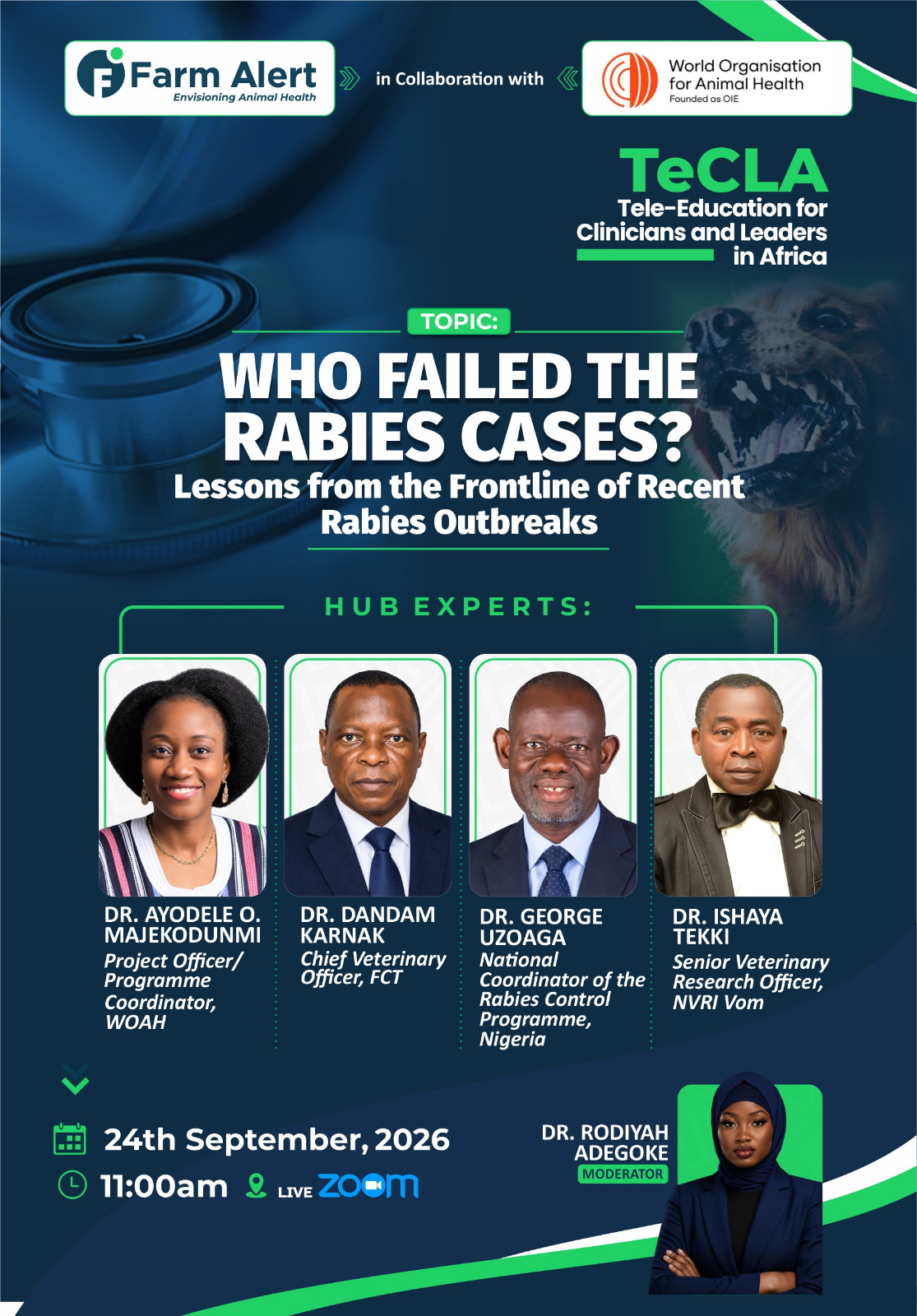
Farm Alert’s September edition of its TeCLA (Tele-education for Clinicians and Leaders in Africa) series brought veterinarians, medical professionals, laboratory experts, policymakers and other animal-health stakeholders together on 24 September to examine a question that sits at the centre of Nigeria’s continuing rabies challenge: where does the response fail before a preventable disease becomes fatal?
Held four days before World Rabies Day, the session, titled “Who Failed the Rabies Cases? Lessons from the Frontline of Recent Rabies Outbreaks,” focused on recent rabies cases in Nigeria, particularly developments in the Federal Capital Territory, while examining gaps in surveillance, diagnosis, reporting, vaccination, post-exposure care and community response.
The virtual session recorded 338 registrations from at least 13 countries, with more than 200 participants actively joining the programme. Veterinary practitioners accounted for 151 registrants, while 81 were veterinary students, alongside participants from public health, laboratory science, medicine and policy.
Rather than treating rabies as a single-discipline problem, the session brought together perspectives from across the response chain, including frontline veterinary and medical professionals, laboratory expertise, Nigeria’s National Rabies Control Programme and an international perspective from the World Organisation for Animal Health (WOAH).


𝗘𝗶𝗴𝗵𝘁 𝗖𝗼𝗻𝗳𝗶𝗿𝗺𝗲𝗱 𝗖𝗮𝘀𝗲𝘀, 𝗕𝘂𝘁 𝗮 𝗠𝘂𝗰𝗵 𝗟𝗮𝗿𝗴𝗲𝗿 𝗦𝘂𝗿𝘃𝗲𝗶𝗹𝗹𝗮𝗻𝗰𝗲 𝗤𝘂𝗲𝘀𝘁𝗶𝗼𝗻
One of the key issues raised during the discussion was the relationship between confirmed cases and the actual burden of rabies.
The FCT has recorded eight confirmed rabies cases in 2026, with two associated human deaths. However, discussion during the session highlighted that confirmed cases should not automatically be interpreted as the full extent of transmission.
Under Nigeria’s Integrated Disease Surveillance and Response framework, rabies is treated as a disease for which a single confirmed case constitutes an outbreak. This makes timely detection and reporting particularly important because the absence of confirmed cases does not necessarily establish the absence of transmission.
The FCT presentation also pointed to weaknesses in detection and reporting, particularly in rural communities where dogs may be kept for hunting, security or other purposes and may have limited access to routine vaccination and veterinary services.
The discussion raised the possibility that the reported figures could substantially underestimate the actual burden, particularly where suspected cases never reach a veterinary facility, laboratory or formal reporting channel.
This concern extends beyond the FCT.
Data discussed during the session showed 86 confirmed animal rabies cases over approximately a one-year period, with 48 recorded in Plateau State alone. The concentration was linked, in part, to Plateau’s proximity to the National Veterinary Research Institute (NVRI), Vom, where samples can be submitted for laboratory confirmation.
The figures therefore raised an important surveillance question: are some states reporting more cases because they have more rabies, or because their cases are more likely to reach a diagnostic laboratory?
𝗧𝗵𝗲 𝗟𝗮𝗯𝗼𝗿𝗮𝘁𝗼𝗿𝘆 𝗖𝗮𝗻 𝗖𝗼𝗻𝗳𝗶𝗿𝗺 𝗖𝗮𝘀𝗲𝘀. 𝗚𝗲𝘁𝘁𝗶𝗻𝗴 𝘁𝗵𝗲 𝗦𝗮𝗺𝗽𝗹𝗲 𝗧𝗵𝗲𝗿𝗲 𝗜𝘀 𝗔𝗻𝗼𝘁𝗵𝗲𝗿 𝗠𝗮𝘁𝘁𝗲𝗿.
The laboratory component of the session provided another perspective on the surveillance gap.
According to the laboratory presentation, once an appropriate sample reaches NVRI Vom under suitable conditions, diagnostic confirmation can be completed within hours. Animal rabies testing was described as taking approximately three and a half hours, while human samples tested using RT-PCR require somewhat longer processing.
The more difficult part can occur before the sample reaches the laboratory.
Speakers described cases in which samples have taken days to arrive at the diagnostic facility, with transportation, cold-chain requirements and sample handling presenting significant challenges. The discussion also highlighted incidents in which samples transported in ice-packed containers were reportedly mistaken for food and stolen in transit.
For surveillance to work effectively, therefore, identifying a suspected case is only the first step. The animal must be sampled appropriately, the sample must be preserved and transported safely, and the result must ultimately feed back into the surveillance and response system.
𝗪𝗵𝗲𝗻 𝗥𝗮𝗯𝗶𝗲𝘀 𝗣𝗿𝗲𝘃𝗲𝗻𝘁𝗶𝗼𝗻 𝗖𝗼𝗹𝗹𝗶𝗱𝗲𝘀 𝗪𝗶𝘁𝗵 𝗟𝗼𝗰𝗮𝗹 𝗕𝗲𝗹𝗶𝗲𝗳𝘀
The FCT cases discussed during the session also highlighted the role of community beliefs and behaviour in determining outcomes after exposure.
The two human deaths associated with the current FCT outbreak were linked during the discussion to dog breeders who had occupational exposure to dogs kept for hunting and related activities.
Both reportedly declined recommended post-exposure vaccination and instead relied on a traditional practice involving killing the suspected dog and consuming its liver.
The cases demonstrated a difficult reality in rabies prevention: awareness of the disease does not automatically translate into acceptance of post-exposure prophylaxis.
For an exposed person, the critical decisions have to happen before symptoms develop. Wound washing, prompt assessment, administration of rabies vaccine and, where indicated, rabies immunoglobulin can prevent the infection from progressing.
Once clinical symptoms appear, however, rabies is almost invariably fatal.
This makes the period immediately following a bite or other exposure one of the most important points in the entire response chain.
𝗧𝗵𝗲 𝟳𝟬% 𝗖𝗵𝗮𝗹𝗹𝗲𝗻𝗴𝗲
The WOAH perspective brought the discussion from individual cases to the scale required for national elimination.
Dog-mediated rabies transmission can be interrupted through sustained mass dog vaccination, with at least 70% of the dog population vaccinated annually regarded as the critical coverage level for interruption of transmission.
For Nigeria, the figure discussed during the session translates to approximately 9.1 million dogs requiring vaccination every year.
The scale is significant because dog vaccination cannot be treated as a one-off campaign. Maintaining protection requires sustained annual coverage.
Nigeria’s National Rabies Control Programme acknowledged the scale of the task during the session, particularly given the size of the country’s dog population, the geographical spread of communities and the resources required to maintain vaccination campaigns.
The discussion also examined the role of international support, including WOAH programmes and vaccine-bank mechanisms, and the challenge of maintaining interventions beyond individual project cycles.
𝗪𝗵𝗮𝘁 𝗧𝗵𝗲 𝗔𝘂𝗱𝗶𝗲𝗻𝗰𝗲 𝗦𝗮𝗶𝗱 𝗕𝗲𝗳𝗼𝗿𝗲 𝗧𝗵𝗲 𝗦𝗽𝗲𝗮𝗸𝗲𝗿𝘀
The session’s pre-session poll provided another indication of where professionals perceive the weaknesses in the response.
Of the participants who responded, 113 identified public awareness and early reporting as the weakest link in Nigeria’s rabies response, ahead of dog vaccination and laboratory diagnosis.
The result was particularly notable because the audience was heavily made up of people already working or training within animal health. The 151 veterinary practitioners and 81 veterinary students represented roughly two-thirds of registrants.
The response therefore reflected the views of a largely professional audience already familiar with rabies prevention and control.
It also reinforced one of the recurring themes throughout the session: the challenge is not confined to knowledge of rabies. It extends to how information, services, samples and patients move through the health system after an exposure occurs.
𝗔 𝗢𝗻𝗲 𝗛𝗲𝗮𝗹𝘁𝗵 𝗣𝗿𝗼𝗯𝗹𝗲𝗺 𝗙𝗿𝗼𝗺 𝗕𝗶𝘁𝗲 𝘁𝗼 𝗗𝗶𝗮𝗴𝗻𝗼𝘀𝗶𝘀 𝘁𝗼 𝗧𝗿𝗲𝗮𝘁𝗺𝗲𝗻𝘁
The central lesson from the discussion was that rabies response does not sit within one institution.
A suspected rabid dog may first come to the attention of a farmer, dog owner or community member. A veterinarian may then be required to assess the animal and initiate the appropriate response. A sample may need to reach a laboratory for confirmation. If a person has been exposed, that individual needs rapid access to appropriate post-exposure care.
Each stage involves a different professional or institution.
A breakdown at any point can delay the next.
This is why the session brought together actors from veterinary practice, human medicine, laboratory diagnostics, government and international animal-health structures. The cases discussed demonstrated how closely animal and human health outcomes remain connected in rabies control.
𝗙𝗮𝗿𝗺 𝗔𝗹𝗲𝗿𝘁’𝘀 𝗧𝗲𝗖𝗟𝗔 𝗦𝗲𝘀𝘀𝗶𝗼𝗻 𝗖𝗹𝗼𝘀𝗲𝘀 𝗪𝗶𝘁𝗵 𝗔 𝗖𝗹𝗲𝗮𝗿𝗲𝗿 𝗣𝗶𝗰𝘁𝘂𝗿𝗲
The September TeCLA session did not end with a single answer to the question in its title.
Instead, the two-hour discussion mapped several points at which rabies cases can be lost: delayed recognition, weak reporting, limited access to veterinary services, difficulties transporting diagnostic samples, gaps in dog vaccination, delayed post-exposure care and community practices that can compete with evidence-based treatment.
For a disease that can be prevented through vaccination and timely post-exposure intervention, those gaps remain consequential.
As Nigeria works towards the global goal of eliminating dog-mediated human rabies, the experience from recent cases suggests that progress will depend on how effectively these different parts of the response operate together, from the community where a bite occurs to the laboratory where a sample is confirmed and the health facility where an exposed person receives care.
“Who Failed the Rabies Cases? Lessons from the Frontline of Recent Rabies Outbreaks” was hosted by Farm Alert through its TeCLA series, with participation from experts across Nigeria’s veterinary, medical, laboratory and rabies-control systems, alongside an international perspective from WOAH.
The full session is available on YouTube AT [https://youtu.be/xFtM7_1frko] for professionals, students and other stakeholders interested in rabies prevention and One Health practice.


























Leave a Reply