
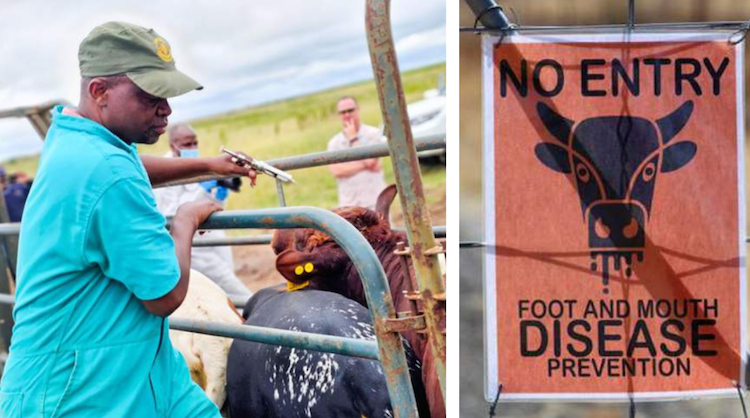
South Africa’s fight against Foot-and-Mouth Disease (FMD) is entering a critical phase, as new outbreak data reveals both escalating spread and significant progress in vaccination efforts.
According to the South African Department of Agriculture, the country is currently managing over 1,300 confirmed cases of FMD across all nine provinces, with the Free State emerging as the epicentre of the outbreak.
Free State at the Centre of the Outbreak
Provincial data shows that the Free State has recorded:
- 433 outbreaks (provincial tracking)
- 328 officially confirmed cases reported to the
World Organisation for Animal Health
This discrepancy reflects differences in reporting systems:
- Provincial figures include suspected and active cases under investigation
- WOAH figures include only confirmed and formally notified outbreaks
Across the country, the distribution of cases highlights the scale of the crisis:
- North West – 247
- Gauteng – 241
- KwaZulu-Natal – 225
- Mpumalanga – 140
- Eastern Cape – 71
- Limpopo – 49
- Western Cape – 13
- Northern Cape – 3
Underreporting and Weak Biosecurity Fuel Spread
Despite rising case numbers, a more concerning issue is emerging:
Farmers are increasingly failing to report suspected cases
According to authorities, this:
- Violates national law
- Obscures the true scale of the outbreak
- Disrupts vaccination planning and response strategies
Under Section 11 of the Animal Diseases Act (Act 35 of 1984), livestock owners are legally required to:
- Report suspected infections
- Implement measures to prevent disease spread
At the same time, declining adherence to biosecurity protocols is accelerating transmission between farms-undermining national control efforts.
This aligns with global concerns raised by the
Food and Agriculture Organization of the United Nations and the
World Organisation for Animal Health, both of which identify surveillance gaps and poor compliance as major drivers of FMD spread.
Mass Vaccination Strategy: Over 2 Million Animals Covered
In response, South Africa has rolled out an aggressive vaccination campaign.
According to
John Steenhuisen:
- 2,033,289 animals have been vaccinated between February and March 2026
- The rollout follows a risk-based strategy, prioritizing high-density livestock areas
- 312,414 cattle vaccinated in the Free State alone
Early Signs of Impact
Initial field data shows:
No new breakthrough infections in vaccinated herds
While this suggests the vaccination programme is effective, authorities caution that:
- Monitoring must continue
- Vaccine-strain matching remains critical
Vaccine Supply Ramps Up
To sustain the campaign, South Africa has secured large volumes of vaccines through international and local partnerships:
- Biogénesis Bagó → 2.5 million doses
- Dollvet → 1.5 million doses
- Additional millions of doses expected before end of April 2026
Procurement and coordination are being managed through
Onderstepoort Biological Products
Dairy Sector Receives Priority Protection
Recognizing the economic importance of dairy production, the government has prioritized this sector in the vaccination rollout:
- All dairy farms in the Free State → vaccinated
- Major dairy operations in Western Cape → covered
- Vaccine doses distributed through the
Milk Producers Organisation:- Eastern Cape → 78,000 doses
- KwaZulu-Natal → 350,000 doses
This targeted approach reflects efforts to:
- Protect food supply chains
- Minimize economic disruption
Improved Surveillance Driving Case Detection
Authorities note that rising case numbers are partly due to:
- Enhanced surveillance systems
- Centralized reporting via the FMD Command Centre
- Detection of sub-clinical infections
This is consistent with global disease control patterns, where improved monitoring leads to:
Higher reported cases-but better outbreak control
New Vaccination Policy on the Horizon
South Africa is also moving toward a more structured long-term response.
The Department has announced plans to introduce a Routine Vaccination Scheme for FMD (RVS-FMD) under national legislation.
- Public consultations closed: 17 April 2026
- Expected publication: 24 April 2026
This signals a shift from:
Emergency response → Institutionalized disease control
A Broader Warning for Africa
While South Africa manages its domestic outbreak, the global context is becoming more urgent.
The
World Organisation for Animal Health
has warned that FMD SAT1 is spreading internationally, moving beyond its traditional African range.
This raises critical questions for countries across the continent:
- Are surveillance systems strong enough?
- Are vaccination strategies aligned with circulating strains?
- Can compliance be enforced at farm level?
Final Insight
South Africa’s response shows that progress is possible:
✔ Large-scale vaccination is achievable
✔ Surveillance systems can be strengthened
✔ Policy frameworks can evolve
But it also exposes persistent challenges:
- Underreporting by farmers
- Weak biosecurity practices
- Pressure on vaccine supply systems
The Bottom Line
South Africa is not just battling an outbreak-it is navigating a complex transition toward modern disease control systems.
And as FMD continues to spread globally, the lesson is clear:
Control is no longer just about vaccines-it is about systems, compliance, and coordination.


 farmalert.online
For questions Leave a Reply